

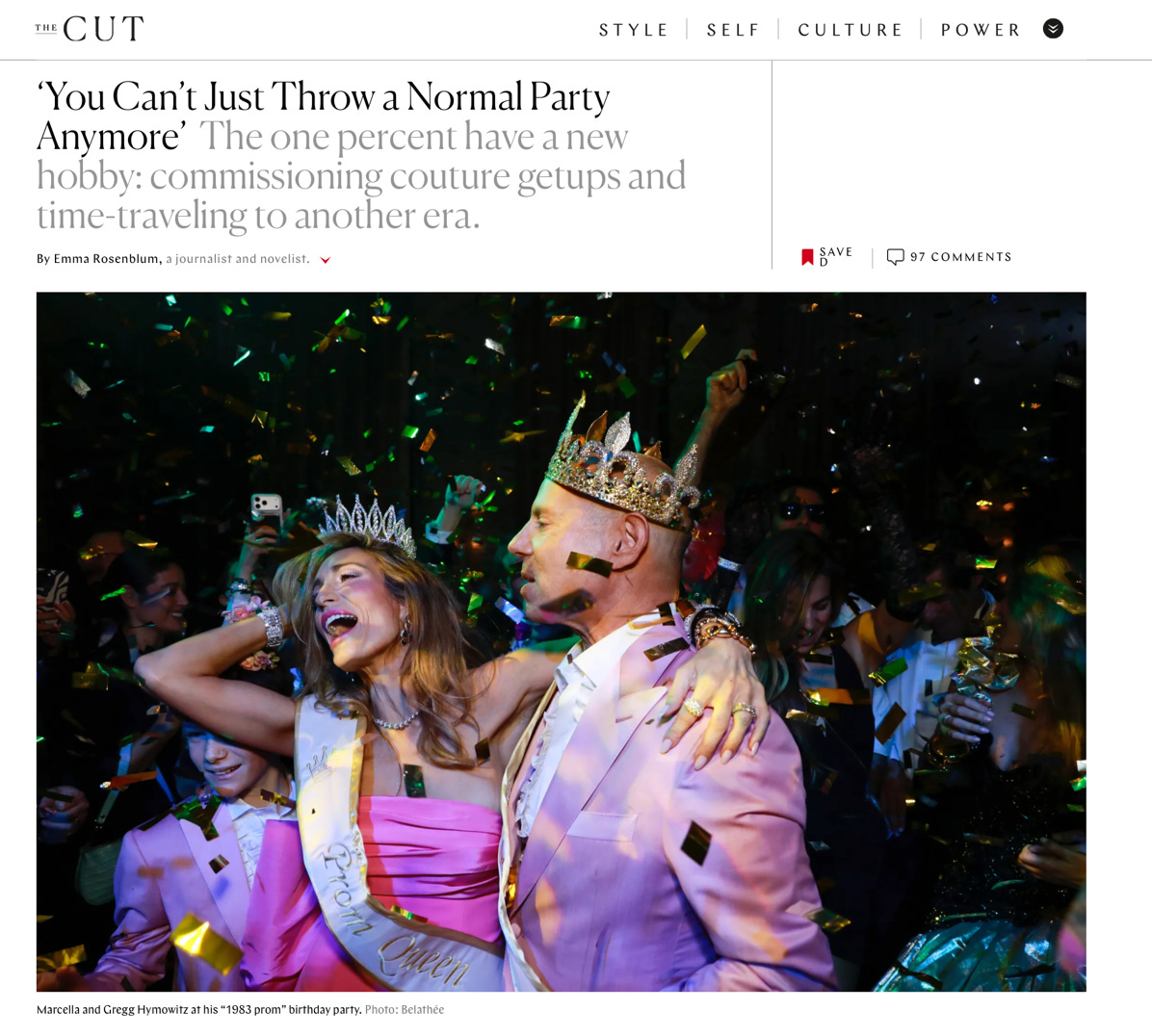
The subject matter of this article in New York Magazine gave me a bad case of “the ick.” (Link at the bottom.)
I’ve contended that the way the media portrays the wealthy is unrealistically skewed to the negative. 1
So it certainly doesn’t help my cause when an extremely wealthy hedge fund executive and his wife choose to splash their extravagance in our faces.
I have no objection to extravagant parties. They help the local economy, which is a good thing. And many people enjoy them. As well, my wife and I have been involved in throwing wedding celebrations for two of our children. Those celebrations were costly. Although we weighed each expenditure against value received and tried to avoid anything that might be considered too over-the-top.
What I object to is not the extravagance itself but the avid self-publicity of “let them eat cake” spectacles like this party. What is the purpose of agreeing to have a magazine write about this event and otherwise hyping it through public social media other than to show off? In a time of hyper-attention to economic inequality, what is the result other than to inflame economic class resentment?
Am I throwing stones from my glass house
It’s a true cliché that a trait we critique, or even despise, in others is often a trait we despise in ourselves. So I have to wonder whether my negative reaction to the article is in part based on my impulse to show off through different means and in a different tone.
After all, this newsletter is a form of social media where I write from the point of view of personal wealth. And while my aim is to give a more balanced view of the wealthy––that not all of us are smug or obnoxious––I can’t be sure if that’s how my posts land.
And even if my aim is achieved, I can’t be certain that my motivation is entirely free of that same impulse I deplore in others––to seek attention for “my success, my money, my fabulous life.”
Do aesthetics matter
My wife Debbie’s aesthetic is understated elegance and maximum personalization, and whatever she can do by herself she does. She is her own party planner.
The little details that my wife loves to deploy––delicate flower arrangements that follow the colors of the rainbow or wedding pictures of our ancestors at our child’s wedding––might seem invisible and restrained to the point of dullness to givers of elaborate themed parties like the one featured in the article. Here’s a snippet from the article.
“And they’re going all out, embracing obscene excess. ‘Everyone is one-upping each other. Someone throws a party, someone wants to throw the next one, everyone’s posting it on social’.”
However, what might seem declasse to us might be seen as great and clever fun to others. Each to their own taste.
A digression–what makes an evening successful
As with aesthetics, different people will have different notions of what makes a wonderful party or evening. I’d dread going to one of these types of parties. No worries about that, especially after this is published! My wife and I are not on that circuit.
In the same New York Magazine article, a Greenwich, CT woman notes that a penchant for frequent and fancy theme parties has travelled from New York City to the suburbs. These evenings are preferable, she says
“to the same four restaurants, with the same four couples, talking about kids and vacations and ‘Should we split the Brussels sprouts to start?’ The theme parties shake it all up.”
I agree with the first part of that sentiment. I too don’t really want to hear about vacations or kids other than a quick and polite exchange. As well, I’m a fan of decisive menu orders, I don’t like to share my food (exception for dessert), and I will not eat Brussels sprouts.
[Editor says, “you sound like so much fun! And, don’t forget, we met at a Halloween party!”] 2
I like to be in pleasant, quiet, and intimate settings with kind people who bring varied perspectives. Or, who teach me something new. Or, who make me laugh. I find that writers and artists (and my children and brothers) generally tend to be the best at this. Although I can think of friends in business who have a gift of going off on hilarious tangents and telling wonderfully strange stories.
Back to the main point
Most people are restrained in their actions by a desire to be seen as kind and humble. Or to put it another way, most people will feel ashamed if they are viewed as arrogant.
Adam Smith in his Theory of Moral Sentiments writes that the restraint of prospective shame is governed in most of us by an inner and “impartial spectator” who warns us when we are about to act in a way that will prevent people from finding us lovely in character. As Russ Roberts (no relation) writes in his wonderful book How Adam Smith Can Change Your Life:
“The successful man will mute his trumpeting of his good fortune.”
When the impartial spectator is nowhere to be found we risk becoming prideful to the point where people wish us ill.
The futility and evanescence of that Pride is captured well in the final lines of Shelly’s poem Ozymandias about an ancient statue in the desert whose “shattered visage” lies “half-sunk” in the sand.
“And on the pedestal, these words appear:
‘My name is Ozymandias, King of Kings;
Look on my Works, ye Mighty, and despair!’
Nothing beside remains. Round the decay
Of that colossal Wreck, boundless and bare
The lone and level sands stretch far away.”
Here is a link to an excerpt from the article that sparked this essay. It’s on New York Magazine’s new Substack. The full article is paywalled but if you’re not a subscriber, you get a few free articles per month.
Question for the comments: Do you object to the extravagance or the publicizing of it or both?
The “editor” is my wife Debbie.
some people “fly” too close to the sun
One of the greatest gifts I gave to myself in 2025 was shutting down all Social Media except Substack. It simply wasn’t bringing me joy and I found it to be a colossal waste of time. I give Substack a pass because reading and engaging here challenges my worldview.
I think the compulsion to seek validation online is evidence of something lacking internally in the poster. Lack of self acceptance reflected through seeking acceptance from others. It’s interesting how one can have hundreds of thousands of “followers” and still be lonely and depressed.