

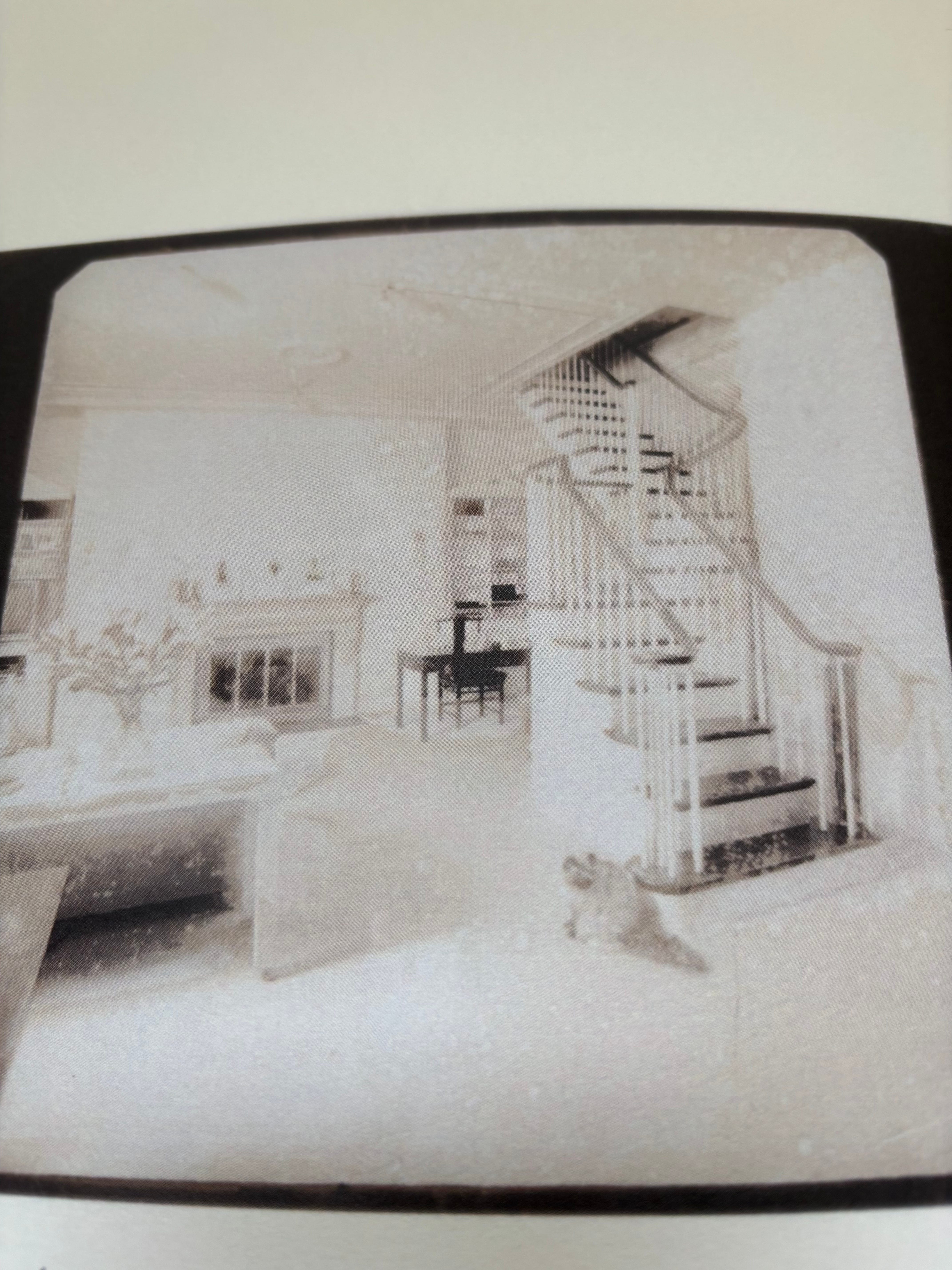
In 1987, Debbie and I, ages 24 and 25, purchased a completely inappropriate Upper West Side apartment in anticipation of having our first child. It was a duplex with a steep staircase, theatrical in its height, leading up from the tiny kitchen and large living room to the two small bedrooms.
We were charmed by the staircase, which was from an actual stage set. Or so we were told. The charm faded once we experienced the reality of endless trips up and down the many steep stairs to fetch the endless material needs of our baby.
The apartment had good light from the west. We looked out from a distance upon an ABC studio building. However, known to everyone but us, ABC had decided to expand and was poised to begin constructing a brick building up to the property line, just a few feet away from all our windows. There would be many months of noisy work and construction workers who could peer in at us. When it was done, our light would be extinguished.
Before we closed on the apartment, we asked our four NYC-based parents to come see it. We don’t remember whether they came, but now we look back in wonder that not one of them asked us any questions or asked us if we had done our due diligence. They let us learn our own lessons.
When a stray brick crashed through one of our windows and soon thereafter all of Debbie’s jewelry was stolen by one of the workmen, the lessons hit home very hard. And when we sold the apartment, we took a loss despite a boom in NYC co-op prices during our ownership.
As for our missing in action parents, they were living their lives and we were living ours.
Under Parenting
Throughout the decades, I complained at great length to many therapists about my parents. Mostly, about their hands-off approach. Their selfishness, their aloofness. One bored male therapist, couldn’t take my kvetching anymore and yelled at me “to just grow up.” 1
My perspective today is that my parents’ hands-off approach was just fine. After all, I’m happy with the person I am, including my relationships with my own children. These are dispositive points.
My parents were definitely more interested in themselves than in their children. They frequently traveled, mostly to weeklong national bridge tournaments, and we had governesses when we were young.
Ideally, we didn’t bother them with any troubles and instead were sources of fun and amusement. Watching sports and playing ping-pong with my father, a shared fanatical love of the New York Islanders with my mother.
My father valued having a stock of funny stories to tell. On one parent-teacher day, he delighted in telling my biology teacher one of his favorites. That at Cornell in the 1950s he’d blown up the chemistry lab, which, together with his terrible grades, had gotten him expelled. 2
At another school gathering, my father accused my headmaster of running a school that lacked academic rigor. My father never saw me doing any homework, yet I was getting straight “A’s.” This turned into a good “story” for my father when the headmaster told him that he’d never heard such a peculiar and astonishing complaint from any other parent.
As for my mother, she was always searching for her purpose beyond being a wife and mother, and that search absorbed most of her attention and made her often unhappy until she found her calling. 3
My mother’s interventions when I was growing up were infrequent, but when she felt strongly about my going off course, she was fierce, as when she sabotaged my relationship with a girl she decided was unsuitable for me. She was right in the end but her means were cruel.
Over Parenting
I’m glad I had parents who were mostly self-centered rather than parents who lived their lives through me or considered me some sort of status symbol. Of course I’m not suggesting those are the only two parenting choices, but parental self-centeredness seems far healthier for a parent-child relationship than the burden of making a child the center of a parent’s life.
Trophy children

In Ann Patchett’s new novel Whistler, Patchett’s fifty-something heroine Daphne is a child of divorce with a difficult mother but a wonderful sister Leda. The two sisters have turned out fine. They are (annoyingly) self-satisfied with their resilience and grit.
Daphne teaches literature at an elite all-girls private school in Manhattan (think Brearley or Spence or Gossip Girl/NYC Prep). The two sisters dish out contempt for these teenage girls and their wealthy parents in contrast to their own upbringing.
Daphne’s sister Leda observes that Daphne’s students are the kids to worry about today.
“…the ones who are the singular light of their parents’ lives, the ones who hit thirty and are still calling their mom five times a day.” 4
Daphne piles on. Her students’ parents “might as well have carried them to school on golden plinths.”
And then Leda says it’s not too much love, but
“too much crippling dependency…which masquerades as love.”
Novelists and essay writers often take a point of view that casts their own life as the best of all possible worlds. Patchett does it in Whistler–––Daphne is an autobiographical character––– and I’m wary of committing the same Panglossian sin in this essay.5
Vicarious parenting

My son Michael and I recently saw the latest (and wonderful) production of Death of a Salesman. The play is not usually considered a commentary on parent-child relationships. But that’s the theme that stood out to me when I saw it this time. Maybe because I was with my son Michael, who’s the same age as the play’s adult children.
The play is the tragic tale of a faltering salesman Willy Loman, a father who invests all his hopes and dreams in his son Biff. The tragedy can be traced to Willy’s own moral failure––teenage Biff catches his father cheating on Biff’s mother. That incident throws the lives of both father and son horribly off course.
But even before the revelation of Willy’s cheating, the doom of both father and son was already sealed by Willy’s monomaniacal obsession with a peculiar type of success for Biff, an adolescent football hero with no academic talent. Willy is constantly telling Biff that all Biff needs for phenomenal business success is to be “well-liked” by the right people.
Willy compares Biff to a demi-god––an “Adonis” or a “Hercules.” Both Willy and his wife note Biff’s golden football uniform and helmet. Willy tells Biff that his charisma and good looks will always win out. He’ll be “five times” as successful as his neighbor and classmate Bernard, a studious academic star who helps Biff cheat on his exams.
Willy is a travelling salesman, and his own success is based on how much people like him and how impressive he looks. But when we meet Willy at the start of the play, he’s no longer “well-liked” or even merely “liked.” He’s a sad old man, and buyers aren’t buying from him. This puts him in financial peril.
Worse, Biff has turned out to be a monumental failure. Biff is back at home as a thirty-four year-old, having drifted around for fifteen years as a “dollar a day” worker. Willy is sixty-three (I can’t believe I’m older now than Willy Loman!). Willy and Biff can’t be in the same room without inflicting great pain on each other.
In one of the cathartic moments near the play’s end, Biff tries to explain to Willy exactly how and why Biff’s life went awry:
“And I never got anywhere because you blew me so full of hot air I could never stand taking orders from anybody! That’s whose fault it is!”
And even at the bitter end (spoiler alert), Willy is still clinging to a desperate, foolish hope that Biff can have a glorious future that will redeem Willy’s own failures. Willy’s scheme, “approved” by Willy’s hallucination of his sinister older brother Ben, is to stake Biff in business with the $20,000 his family will soon collect on Willy’s life insurance.
But that too will be a failure, because the insurance won’t pay out for suicide.
Children are the ultimate judges
My own children have allowed us to believe that we are okay as parents. We’ve always been involved in their lives and we did step in when we thought we could help. Undoubtedly, not always in a way that was welcomed.
We see and speak and text with our children frequently. I don’t keep score but I think they contact us as often as we contact them. And now that our very young grandchildren are in the mix, we are available as babysitters so our status has risen.
Whether we’ve been over-involved is not our call. Ultimately, it’s up to children to pass judgment on their parents.
And a child’s judgment that contains the full sweep of right and wrong and the complete record of unanticipated and permanent memories of their parents––vagrant, capricious moments, some loving, some painful––is a judgment that parents may not care ever to hear.
Rather, a judgment of such radical transparency is a custom more honored in the breach. 6
Question for the comments: On the continuum between under parenting and over parenting, where do you stand?
Carly Simon’s Legend In Your Own Time, a beautiful and haunting song with relevant lyrics.
“Well I have known you
Since you were a small boy
And your momma used to say
"Well my boy's gonna grow up
And be some kind of leader someday"
Then you turn on the radio
And sing with the singer in the band
Your momma would say to you
"This isn't exactly what she had planned"
That therapist’s outburst against me was not entirely unlike Vito Corleone slapping the face of his godson Johnny Fontaine and yelling at him “you can act like a man.”
I can imagine my puzzled biology teacher trying to explain to my father that there is in fact a difference between biology and chemistry.

Editorial comment from Debbie: “What’s wrong with calling me five times a day!”
An arguably gratuitous reference by me to Dr. Pangloss from Voltaire’’s Candide.
Shakespeare’s Hamlet and his friend Horatio hear the far sounds of a drunken party held by Hamlet’s evil Uncle Claudius. Horatio asks Hamlet whether such carousing is now the custom in Denmark. Hamlet says it is and then says:
“But to my mind, though I am native here, and to the manner born, it is a custom more honored in the breach than in the observance.”
Note that the meaning of honored in the breach has nothing to do with the frequency of the custom but, instead, whether it is a good or bad custom. If bad, it should be avoided, i.e., breached.
Note also that it is to the manner born, not to the manor born.
It's interesting... I have never really thought in terms of over or under parenting. Instead, I've always been fixated upon breaking cycles of trauma and abuse, and not doing the same harm. My child is 12, and I haven't been able to avoid everything I went through—I'm a disabled single mother with health problems and hoped to avoid poverty. But... I have been able to remember this whole time that I'm not just raising my daughter, I'm nurturing our future relationship when she's grown up. I began with attachment parenting but today, I suppose I fall somewhere in the middle. I do allow her to make age appropriate mistakes without intervention, and I focus more on natural consequences versus creating punishments for her—I think that's important.
I saw parenting as evolving. I went 100 percent at birth. I devoted myself to my children and was extremely nurturing and protective. But my goal was to adjust constantly so that by the time they left the nest, they’d be independent.
I chose this approach because my parents were very controlling and then when I escaped, I went too far in claiming my freedom (and was inexperienced in life so made some non-prudent decisions.)
I wanted my kids to become independent gradually.
They watched so little TV growing up that my daughter’s partner “complains” that she seldom gets his clever pop culture references from the past.
But I unprotected them as they got older. After watching “Boyhood” with me as a young adult, my son said he had had the least rules of any kid he knew “except for the ones whose parents didn’t give a crap about them.” I trusted my kids to make good decisions as teens.
I think my approach worked. We escaped the teen drama and rebellion and both my kids — in their 30s — are living very good lives now.