


My wife was away skiing this week. As I often do when I’m alone, I went over to the Upper West Side to catch up with my friend Tommy. He and I have a relationship built on loneliness, although mine is temporary while his seems more or less permanent.
After spending time with Tommy, I always have an urge to help him. He deserves to be with someone who loves him. I think Tommy’s good points outweigh his bad ones. You be the judge.
Tommy’s profile
Looks
Tommy’s a good-looking man. He’s tall and broad with thick, blond hair the “color of whitened honey.” At the age of forty-four, he’s on the big side, not fat but perhaps stout or sturdy. But it’s nothing that some time at the gym or a GLP-1 can’t fix. The good news is that he’s hard on himself, never in denial. He calls himself, unfairly I think, a “hippopotamus.”
When Tommy was a college freshman, a Hollywood talent scout saw his picture and called him in for a screen test. Admittedly the talent scout was on the lowest link of the industry’s food chain, but he thought Tommy might be the perfect actor to play “the guy who loses the girl.” That led Tommy to quit college and try his luck at acting in LA. He did not find luck.
Tommy’s current domestic situation
Tommy has two women, both of them quite pretty if not beautiful, who want to be with Tommy but circumstances prevent him from being with either. He’s legally married but he and his wife have been separated for four years. He has two boys, fourteen and ten. He supports his wife and boys,
It’s hard to say what went wrong with the marriage although Tommy will say that he married in haste, against his own better judgment. Tommy’s harsh, old-fashioned father has speculated that there might be “bed-trouble.”
Tommy would like to marry his girlfriend. As far as I know Tommy did not cheat on his wife before the separation. And his wife currently dates other men. The issue with Tommy’s girlfriend is that she’s a devout Catholic and won’t stay or even be seen with him until he gets a divorce, which his wife refuses to give him.
So Tommy is caught in a vise between the two women.
His wife’s strategy is to make Tommy’s situation so miserable that he will come back to the marriage. I only have one side of it but his wife seems like a very hard and unpleasant person.
They each have divorce lawyers. Tommy’s willing to give his wife all he has, but his wife keeps moving the goalposts. As Tommy says, “the lawyers talk and send bills and I eat my heart out.”
For what it’s worth, Tommy tries to be a good father. In addition to sending money to support his sons, he takes them to baseball games on the weekend.
Tommy has so much love to give but right now he can’t seem to find an outlet for it.
Tommy’s financial Situation
Tommy lives in a residential hotel on the Upper West Side. Not one of the new, super luxury ones like One Central Park West at Columbus Circle but one of the older pre-war ones further uptown on Broadway, similar to the Ansonia, a Stanford White building that Tommy likes to stare at.
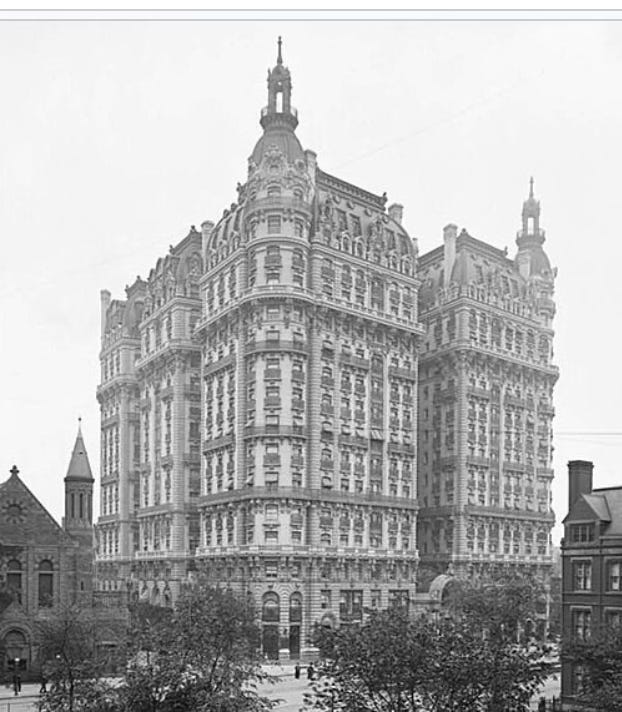
Tommy likens the Ansonia to a “baroque palace from Prague” and notes its “towers, domes, huge swells and bubbles of metal gone green from exposure.”
My boy Tommy has a way with words.
Tommy is recently unemployed. He was a high-level sales executive, earning an upper-middle-class income (which put him in the 32% tax bracket). He quit because the owners wouldn’t give him equity and diminished his position by bringing in someone above him. Tommy’s currently weighing his career options.
As for Tommy’s balance sheet, it’s admittedly not a pretty picture. A malevolent huckster named Tamkin, who may or may not be a doctor, has preyed upon Tommy’s fears that he is missing out on the speculative boom in the financial markets.
Tamkin made day-trading sound simple. Get in, watch your position tick up, and then get out with a profit. Tamkin taunted Tommy by asking him how he could possibly sit still and do nothing and watch everyone else make money. He lured Tommy in by tales of people making five, ten thousand, or more a week, doing nothing but watching the tape.
Money is oppressive to Tommy. Despite his potential to make a good living as a sales executive, his soul rebels against hyper-capitalism. He hates that the world has made it “shameful” not to have money.
Nevertheless, Tommy was gripped by Tamkin’s incitement of FOMO, the “fear of missing out.” Tommy gave Tamkin all his money and the authority to trade with it. Tamkin took some highly leveraged positions which crashed. Tommy lost everything he had, which wasn’t that much to begin with..
I want to make it clear that Tommy did not consult me before getting mixed up with this Tamkin character.
Tommy’s father
Tommy’s mother is dead and he’s estranged from his sister. His father is a wealthy retired doctor who lives in the same residential hotel. Tommy’s father is a tightfisted and coldhearted bastard. He refuses to provide any financial help to Tommy. In fact, he never has.
More than money, Tommy just wants some sympathy or empathy from his father. Instead, his dad is constantly critical of the choices Tommy has made. He doesn’t want to be burdened by Tommy’s “confusions.”
Tommy told me about a breakfast with his dad in the hotel dining room. His dad bragged about Tommy’s lucrative former job in front of his friend. But as soon as the friend left and he and Tommy were alone, his dad started in with Tommy about his sloppy appearance and the domestic and career messes he’s made. His dad’s also been on Tommy for taking too many prescription pills. His dad has a point about the pills.
Tommy’s dad has said things like this to Tommy’s face”
“I see other elderly parents here with children who are no good, and they keep backing them at a great sacrifice. But I’m not going to make that mistake.”
Tommy is truly, sadly, deeply alone.
My kinship with Tommy
I can relate to Tommy’s loneliness.
I was a shy boy, scared of girls, and without anything to be confident about. I recall being alone in my room most nights and weekends. And dreading, with that telltale pit in my stomach, the approach of Sunday night bedtime, because I knew I’d wake to Monday morning and have to go to school.
Back then, I never said to myself, “I’m lonely,” but instead I distracted myself by playing games against imaginary opponents or reading fantasy books. A complete immersion in different worlds could shield me against feelings that were too painful for me to handle at that age.
Now as an adult, my circumstances have changed with a large family and many dear friends. Still, when I’m alone and triggered, my childhood loneliness comes back to haunt me. It can sting more than the original, because as an adult I’ve lost my childhood ability to escape completely into an imaginary world of a game or a book.
Memories of childhood are more poignant when you’re older. You look back over a longer vista of your life, and you realize that your childhood stands out, a mountain range that formed your life’s landscape.
They’re unpredictable, these feelings of despondency. They’re usually short-lived, but twice they lasted, not for hours or days, but for many months. Those were awful periods, times I could say I was depressed.
Tommy Wilhelm’s lonely and beautiful soul
As you may have already surmised, my friend Tommy was born not of man and woman but from the imagination of Saul Bellow who breathed life into him through the pages of his 1956 novella, Seize the Day.
A great author allows us to know a character with a completeness and clarity we rarely meet in real life. Bellow lets us see into Tommy as he really is, a profoundly lost and lonely soul. And in understanding and empathizing with Tommy, I recall the loneliness of my childhood but in a kinship which makes me feel somehow better.
At the end of the novella, after Tommy’s lost every penny, Tommy wanders into a funeral home where a dead man, a stranger, lies in an open coffin. The sight of the dead man breaks the dam of Tommy’s sadness and he begins to cry “with all his heart.”
Here’s the last paragraph of the novella.
“The flowers and lights fused ecstatically in [Tommy’s] blind, wet eyes, the heavy sea-like music came up to his ears. It poured into him where he had hidden himself in the center of a crowd by the great and happy oblivion of tears. He heard it and sank deeper than sorrow, through torn sobs and cries toward the consummation of his heart’s ultimate need.” 1
What is “deeper than sorrow” and the “heart’s ultimate need?” To me, it’s loneliness and the desperate need for connection. In the funeral parlor, Tommy finally finds a shared connection of loneliness with a dead stranger, for who can be more alone than the dead?
This connection with the dead man, fellow sufferer of loneliness, provides an outlet for Tommy to express pity for someone other than himself. And in that he finds a release.
Notes:
All words in quotes are from Seize The Day, either verbatim or closely paraphrased.
I have written about Tommy and Seize the Day before, in the fall of 2023, here.
And below is what continues to be my favorite loneliness song. Janis Ian’s At Seventeen.
Question for the comments: Who are the fictional characters who you consider to be friends?
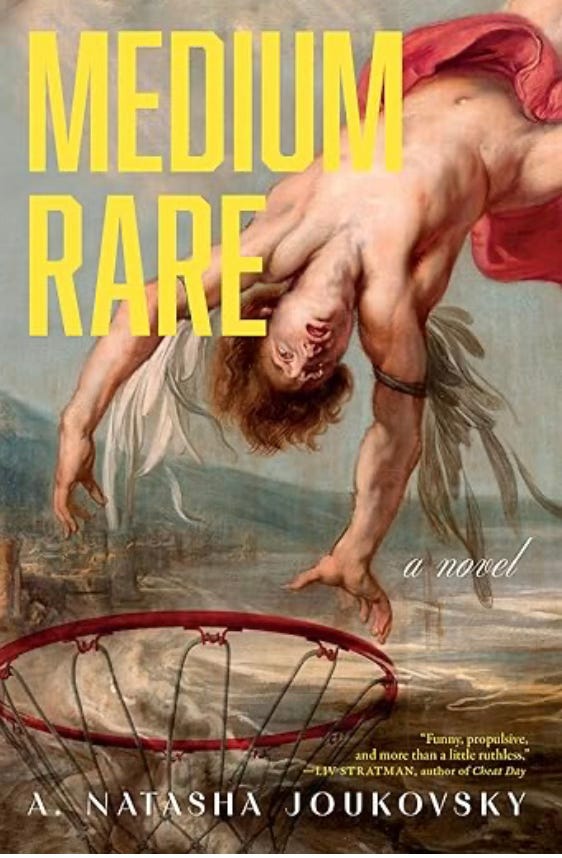
On Tuesday, February 17th at 5:30 PM, I’m going Live with a. natasha joukovsky to discuss her new novel MEDIUM RARE, out March 3rd. I devoured an advance copy.
We won’t spoil the plot but we will discuss some of the book’s juicy themes, which include the gamification of everything, March Madness, status choices in marriage, and infidelity.
Tuesday, February 17th at 5:30 PM EDT
Use this link to put it in your calendar.
This final paragraph gives me a similar feeling to Joyce’s final paragraph of The Dead.
“Yes, the newspapers were right: snow was general all over Ireland. It was falling softly upon the Bog of Allen and, further westwards, softly falling into the dark mutinous Shannon waves. It was falling too upon every part of the lonely churchyard where Michael Furey lay buried. It lay thickly drifted on the crooked crosses and headstones, on the spears of the little gate, on the barren thorns. His soul swooned slowly as he heard the snow falling faintly through the universe and faintly falling, like the descent of their last end, upon all the living and the dead.”
I haven’t had a fictional friend since I broke up with Holden Caulfield, but I still believe Anne Frank would have been a wonderful friend—funny, open hearted, curious and searchingly honest. Through the diary, I see the woman she never had the chance to become. There’s a particularly delightful moment, cut from the first edition of the diary, in which Anne inspects her genitals with rapt fascination while sitting on the toilet. Her father didn’t want the world to know this Anne, but my heart goes out to the girl discovering her body.
David--boy, this one struck a chord. (Not to mention the Janis Ian song which I must have listened to 100000000 times when I was 17.)
In reading your essay, I think the reason why I love Elizabeth Strout's writing so much was made clear--especially the first Olive Kitteridge. Those essays are about loneliness--about lives that don't quite work out the way a younger version of the protagonist thought they might have. But what's interesting about Strout, is that as the characters progress through her books (they appear repeatedly)--they find peace. Or....rather...they make peace with themselves--and their loneliness and regret. And from that peacemaking--"second chances" are made possible.
Wonderful essay. Thank you. The timing is particularly good given it's another one of those "solo holidays." D