

When something is so pervasive, it becomes difficult to separate it from our reality. That’s the point of David Foster Wallace’s famous 2005 commencement speech This is Water.
In the parable that opens Wallace’s speech, an older fish asks two younger fish, “How’s the water today?”
The two young fish are puzzled. They swim away, and Wallace has one young fish say to the other, “What the hell is water?” 1
Wallace goes on to say that for humans the equivalent of a fish’s water is our default setting to make every moment of our lives, especially the mundane, trivial, and boring moments, all about ourselves, i.e., “me-centered.”
For instance, you’re in traffic and you see every other driver in every other car as just an obstacle in the way of your getting home. These “others” are the equivalent of non-player characters in the unfolding game of your life.
Wallace urges us to recognize that these other drivers actually have lives and needs just as complex as our own. For some of them, the traffic may be far more burdensome than our mild annoyance. For example, a husband may be trying to get his wife to the hospital to give birth.
Wallace advises us to resist that me-centered default setting and instead be intentional about choosing what to pay attention to.
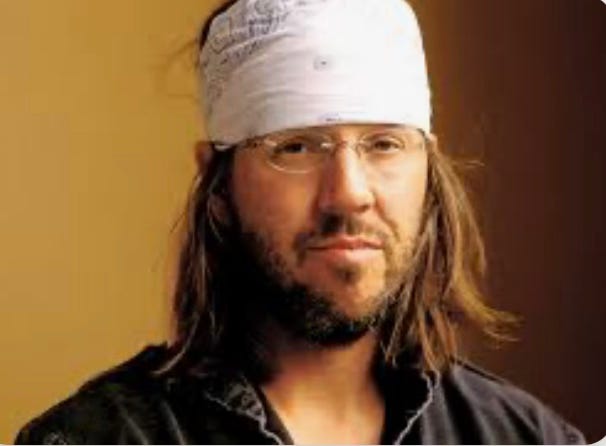
This is water in 2026
Reading Wallace’s speech made me wonder what an equivalent of “This Is Water” might be in 2026. I went back to read again an excellent and thorough essay by Derek Thompson from April titled, If America’s So Rich, Why Did it Get So Sad? 2
Derek identifies the “news” as one of the chief culprits of the disconnect between prosperity and unhappiness.
“Today’s news is more surprisingly negative than at any period of news on record.” 3
Derek is referring specifically to economic news. But let’s consider how much of our attention is dominated by negative news of all sorts.
I’m not suggesting the world has gotten so much worse, although it may feel like it has. What I am suggesting is that we’ve become hyper-aware of all the negativity. Within hours or minutes we become aware of a disaster, a violent crime, an incendiary speech or a scandal. The odious flow is always there. It never stops. The ceaseless availability is what’s new.
Back in 2005, when Wallace gave his speech, there were no iPhones, no Instagram, no Tik-Tok, no Youtube, no Twitter, no AI chatbots, no video-on- demand streaming services.
So, Wallace’s exhortation below had more of a fighting chance in 2005:
“The really important kind of freedom involves attention and awareness and discipline, and being able truly to care about other people and to sacrifice for them over and over in myriad petty, unsexy ways every day.”
Now in 2026, the competition for our attention and awareness includes our always available screens, which by their nature are solipsistic as they involve only one person-–ourselves.
And what’s on those screens inevitably discourages us through the natural negativity of news and, as well, through invidious comparisons with others, which inflames our envy. (I wrote about my own irrational envy of Haley Bieber last year.)4
This is the 2026 water we swim in.
One way to recognize the stink of what we’re swimming in is to turn it all off. To detox, as it’s fittingly called. But I never do that for more than a few hours, which tend to coincide with the hours I’m asleep. No one I know consistently turns it all off.
A good news story
Absent ignoring the world or somehow curating our information flow so it’s all lollipops, sunshine, and butterflies, one way to mitigate the negativity is by paying attention to some positive news. With that in mind, I wanted to highlight the inspiring work done by one of the organizations my wife and I support.
The Hebrew Free Loan Society provides an array of interest-free loans to low and moderate-income people facing financial challenges or needing a helping hand, both within and beyond the Jewish community. They are the only not-for-profit providing a full array of zero interest loans in NYC and its surrounding area.
HFLS makes zero interest loans to address everything from education to housing to debt consolidation and unexpected expenses. Their best known type of loan is “general needs” to borrowers who need to get over a financial rough patch. Every story for every borrower is different. But one thing borrowers have in common is they almost never fail to pay back their loans. HFLS has a 99.9% repayment rate.
I think the HFLS secret sauce is that they require all borrowers to have a guarantor. The guarantor is typically a relative, a friend, or a neighbor. No borrower likes to default. But when someone you know has put themselves on the line for you, the desire to repay that kindness by not calling on your guarantor becomes magnified. I see this as a testament to the fundamental goodness of human nature.
What qualifies as lower and moderate income
The cost of living in the NYC area is very high. So an income that would be considered comfortably middle class or upper middle class in the heartland of America is a very different story in NYC.
A household of four, perhaps a married couple with two kids for example, can be eligible for an HFLS loan even if their family pre-tax income exceeds $100,000 or even $150,000. In NYC, that type of income for a family of four does not make you rich and can leave you vulnerable to all sorts of financial vicissitudes.
A zero interest loan of $5,000 or $7,500 to that family, repayable monthly over a two year period, can make the difference between stabilizing a family’s finances or that family falling into a predatory debt trap with ultimately disastrous consequences.
Impact and history
One of the great aspects of the HFLS model is that with its near perfect repayment rate, any money it receives in support of its mission can be recycled again and again to many borrowers. I love that type of impact.
Another thing I love about HFLS is its long history. It was founded in 1892 by ten leaders of the Jewish immigrant community on Manhattan’s Lower East Side. These friends pooled $95 to create an interest-free loan fund, non-denominational from the start, and made loans starting at 50 cents. 5
Currently, HFLS makes many tens of millions of dollars of loans every year. But it still only serves a small proportion of its ”addressable market,” to use a venture capital-ish term. There are plans to grow.6
Tetiana’s Story
There are many individual stories on the HFLS site. I picked Tetiana’s story, below in italics, because of the tremendous impact HFLS has had on her family. Plus, Debbie supports an organization that helps people in Ukraine where Tatiana’s family is from.7 Plus, cute babies!
“When my husband and I first heard about the Hebrew Free Loan Society (HFLS), we were at a breaking point.
For eight years we had been trying to get pregnant and had exhausted every option available to us. When the doctor told us that our last hope would be extremely costly In Vitro Fertilization treatments, we didn’t know where to turn. That’s when we heard about HFLS’s 0%-interest Fertility Treatment Loan. We applied and quickly received the support we needed to continue pursuing our dream of having a child. Now, one year later, we are blessed to announce that we are the parents of two healthy twins.”

“Our family was happy and at peace, until the crisis in Ukraine began. My father, mother, sister, and my two nieces are all in Ukraine and have found themselves in an impossible situation. Because no one is able to work, they are now lacking the means to afford basic necessities such as food and water.
My husband and I have tried to do everything in our power to help, but with two young children to care for, money is stretched thin; we can’t afford to send the funds that they need. When we received an email from HFLS about the availability of interest-free loans for those with families affected by this devastating situation, we felt as if a weight had been lifted off of our shoulders.
Once again we were able to quickly acquire the funds we needed to help my family, without placing added stress on our own finances. Now we can breathe more easily, knowing that our loved ones have access to the resources they need.
We are incredibly grateful for the help HFLS has provided in both of our times of need and want to send a heartfelt thank you to everyone who contributed to the organization that made these life changing loans possible.”
Unwavering optimism?
I’m told the TV character Ted Lasso represents unwavering optimism. 8

Unwavering optimism is not my default setting. I try to be realistic.
There are many terrible things happening in the world, mostly to people who are without one or more of FDR’s Four Freedoms:
Freedom of Speech
Freedom of Worship
Freedom from Want
Freedom from Fear
But there are many organizations whose mission is to help these people. Sometimes at scale and sometimes one person or one family at a time. That’s good news. So is the fact that most people are decent and want to do the right thing. Consider HFLS and its 99.9% repayment rate.
We can’t dismiss things like this or we’ll lose ourselves to hopelessness, and then the foul waters really will close in over our collective heads.
This Is Water is available in many places on the internet but is not legally in the public domain.
From Derek Thompson’s article:
“In this decade of permacrisis, the news has become exceptionally dire, and we have data to show just how much. A 2024 Brookings analysis of news sentiment found that “news tone has been more negative than the fundamentals would predict during 2018 to 2020 and even more negative than predicted in 2021 to 2023.” Today’s news is more surprisingly negative than at any period of news on record.”
My post about envy:
Hailey Bieber Made Me Feel Bad About Myself

Jet-lagged, tired, and grumpy after my flight home from Europe, I was on the WSJ website and saw a headline about a woman named Hailey Bieber making a billion dollars. I clicked her picture.
Taken from the HFLS web site.
Part of the reason for that small proportion is that HFLS is not as widely known as one might think. As well, with “Hebrew” as the first word in its name, potential borrowers who are not Jewish might mistakenly conclude that they are not eligible. Another cause of borrower hesitation may be skepticism that the loan is really free. Borrowers who apply routinely say, “c’mon, there’s gotta be a catch.”
But there isn’t.
My wife Debbie is very involved with Project Kesher, an organization that helps women and their families, primarily in Ukraine and Israel. HFLS is advising Project Kesher’s effort to make loans to small businesses in the Ukraine. We have great respect for both organizations and their leaders, Karyn Gershon of PK and David Rosenn of HFLS.
I have not yet watched Ted Lasso because my children have berated and teased me for not watching it. I may do a secret watch and I may tell them if I do. There’s a reverse dynamic at play with the Godfather.
Is there a petition I can sign with your kids to get you to watch Ted Lasso?? Because now you’ve gotten me to care about you, and it makes me sad that a person I care about is missing out on one of the top five greatest shows of all time (with a revival season coming out soon, to boot!).
Btw, unwavering optimism is only part of Ted’s makeup. Spoiler alert: the way the show depicts his fears, self-doubts, and anxiety in the face of his outward optimism is humanizingly genius.
I love hearing about groups doing such good work, so thank you for sharing that.
My mom used to say, "Most of us are are good people living good lives, that's why they call it news."