


This week, topics for a post have been ricocheting inside my mind, all of them well-matched rivals fighting for my undivided attention. But time’s up. The week’s over. Saturday morning’s here.
Following are the three topics that have survived a few rounds of my mental Squid Games. 1
The beauty wars come for men
A year ago, I published Beauty, Class, Wealth, one of my most popular posts thanks to the insights of Laura Kennedy on how beauty is an ever changing status game where at the top of the hierarchy the bar is always rising.
For example, when visually obvious cosmetic surgeries like lip fillers and Brazilian Butt Lifts became mainstream, they were rejected by the elite in favor of “traceless transformations.” As Laura put it:
“There’s been a bunch of famous female faces of late that have turned up to events suddenly looking the way they looked 20 years ago, but better. And it’s not clear what’s been done here, but it’s so clear that many things have been done here.
This is the new level of aesthetic aspiration, which is traceless transformation and change. That is something you only have access to through exorbitant sums of money – in the hundreds of thousands of dollars – and social access, because you need to know who can do this for you.”
At the end of that post, I wondered to what extent men would be increasingly engaged in the male version of the “beauty wars.” I caught up with Laura first on Zoom and then this week over dinner in NYC and asked her what she was observing.
Both men and women vying for beauty status, Laura said, have always been able to be thin by simply not eating. And now GLPs have aided that effort. But acquiring muscle is an expensive pursuit in terms of time. So the toned look is not as readily accessible as the thin look.
Specifically, in terms of the male beauty wars, Laura thinks that the stigma of men having “work done” has declined a great deal. And that perhaps the popularity of Clavicular, the original “looksmaxxer,” caring only about his looks, is a sign that young men will increasingly pay more attention to their appearance.
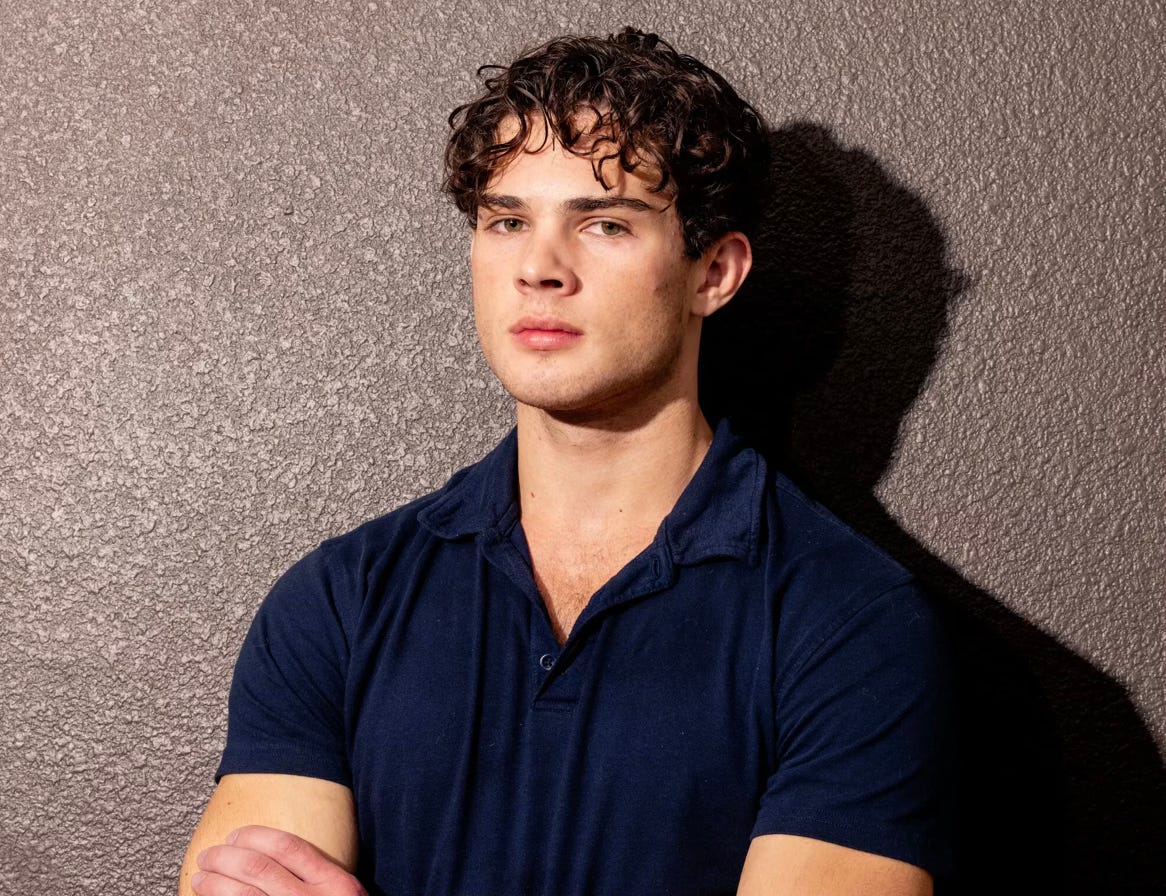
That makes sense to me given the increase in high status women who have good life alternatives to marriage. Accordingly, young men need to increase their attractiveness as mates and while a lot of that can come from behavior, men would be foolish not to focus as well on their grooming and attractiveness.
Dr. Imber
I also spoke to leading Manhattan plastic surgeon Dr. Jerry Imber. He’s been doing procedures for more than four decades. He gave further perspectives on the current state of men and plastic surgery.
Dr. Imber’s clientele is now 35% men. A few decades ago, his male patients were people whose appearance directly affected their income. Actors, salesmen, and even airline pilots!
Now, his male clients are “the same type of guy you’d go to a Knicks game with.” Cosmetic procedures for men have become more mainstream and more socially accepted.
Most of Dr. Imber’s male clients are there to remove bags under their eyes, eliminate double chins, or for liposuction to remove fat around the middle. And yes, I inspected myself in the mirror immediately after speaking with him. 2
Dr. Imber said many of his male patients work out seriously at the gym, treat their bodies as “temples,” and get liposuction because they find no amount of workouts will get rid of their middle fat to their satisfaction.
In terms of the few plastic surgeons who have achieved public notoriety for their work on celebrities and their $250,000 plus prices, Dr. Imber said there are just a few of these “bold-faced” names, and they are the exception rather than the rule. He said he would be “embarrassed” to quote those prices.
He said the idea that you need some sort of special status to get access to a good plastic surgeon was simply not true. He gets his patients through word of mouth.
Last year’s post and discussion with Laura Kennedy below.
Beauty, Class, Wealth

I always hated my teeth so when a friend suggested I get veneers a dozen years ago, I did. The current cost for a great set of veneers, meaning that they look as natural as possible, is about $70,000.
Is AI a bubble
This week I read an essay by Derek Thompson (pay-walled) on recent developments on AI. Previously, Derek had believed that the AI buildout mapped closely to the 19th century railroad boom in which an excess of rail capacity ahead of demand caused financial panics, crashes, etc.
Derek’s latest essay describes how he’s now changed his mind.
“In the last few months, three big things have pushed me toward thinking that AI might be the opposite of a bubble.”
Derek points to Anthropic (Claude) growing its annual recurring revenues from $10 billion a few months ago to $30 billion today, “older” chips increasing rather than declining in value, and a scarcity rather than an excess of computing supply.
Derek now thinks the better analogy to the business of AI is electricity, not railroads.
Derek’s an extremely thoughtful writer and I always learn something from reading his work. And I give him great credit for shifting his views as the facts change.
But he’s not a finance guy.
I’m afraid I was snarky in my comment when I wrote:
What is most remarkable about this article is the absence of two words: Valuation and Profit.
This is akin to Sherlock Holmes’ the dog that didn’t bark in the night or, in this case, the writer writing about the possibility of a bubble who didn’t mention the defining characteristics of a bubble, which, after all, is a financial concept.
To Derek’s further credit he responded by saying that he ought to have focused more on the financial aspects of a bubble in his essay.
I think the analogy to electricity is interesting. However, the companies that generated and distributed electricity soon became geographical monopolies and then utilities. AI has no natural geographical boundaries, and it’s hard to see government allowing a monopoly to emerge.
That still leaves the question of how the aspirational trillion dollar valuations of the independent AI companies, OpenAI and Anthropic, can be justified by net cash flow in such a capital intensive business.
Or, looking at McKinsey’s estimate of $3.7 to $7.9 trillion required by 2030 to build data centers to meet demand, what sort of cash flow would justify that investment? Note that the wide range is based in different demand scenarios.

I wonder for the companies that already have great cash flowing businesses and huge market valuations ––Google, Microsoft, Meta, Amazon, and Apple––whether their investments in AI are a necessary evil. They have to protect their franchises and cannot be left behind.
Does that mean that the independents are doomed to lose because they don’t have the same access to cashflow and financing?
It will be fascinating to find out.
Michigan Democrats and Israel
Last week I wrote about how Israel hatred seems to lead inevitably to antisemitism. I used James Baldwin as an example of a brilliant man who “crossed over.” This week my wife Debbie saw the play Giant about Roald Dahl’s similar journey from Israel foe to antisemite.
In Michigan there’s a three-way race for the Democratic nomination for an open U.S. Senate seat. Israel has become a flashpoint in the race. That’s unfortunate because there are far more pressing issues for Michigan and America than Israel.
I am supporting Michigan State Senator Mallory McMorrow who has impressed me from when I first met her early last year as a smart, grounded, tough politician with good values.
However, the nomination race illustrates what last week I called a wicked problem for American Jews. 3
Stevens
On the “right” is Representative Haley Stevens who is backed by AIPAC, the well-funded pro-Israel lobby that imposes unconditional support for Israel as a purist test. Stevens has fallen to a distant third place in recent polling.
AIPAC recently campaigned against a moderate Democratic New Jersey candidate who was not pro-Israel enough. The effect was to elect the anti-Israel candidate who just won her special election. Great job, AIPAC! 4
El-Sayed
On the left is Abdul-El-Sayed who has recently campaigned with antisemite provocateur Hasan Piker. Piker recently doubled down on his preference for Hamas over Israel “a thousand times over.” If you want to know who Hasan Piker really is, see the clip in this footnote. 5
There is context to El-Sayed’s disastrous decision to invite Hasan Piker to campaign with him. Piker appeared on stage with El-Sayed just a few weeks after a heavily armed Hezbollah-inspired terrorist attacked a Michigan synagogue with 140 children inside the synagogue’s early childhood center. Luckily, the terrorist was stopped by security and ended up killing himself before he could murder any children or staff.
El-Sayed is hoping to follow Zohran Mamdani’s successful strategy in getting elected as Mayor of NYC. Mamdani was elected for many reasons but foremost among them was the appeal of his anti-Israel stance among young progressives, including many young Jews.
A key difference, however, is Mamdani ran against a very weak candidate, Andrew Cuomo. The winner of the Michigan Democratic primary will face a tough Republican opponent in Mike Rogers.
Mallory McMorrow
I support the “centrist” candidate Mallory McMorrow. She has been critical of the Netanyahu government, which I think is appropriate, but has never questioned the right of Israel to exist as a Jewish state.
McMorrow has refused to take any money from AIPAC. And she has justifiably criticized her opponent El-Sayed for campaigning with the hate-filled Hasan Piker.
McMorrow and El-Sayed are effectively tied in the polls. The primary election is not until August so there is still m much time remaining.
I believe that if nominated, McMorrow would defeat the likely Republican candidate Mike Rogers in the November general election. I don’t think El-Sayed would stand a chance.
I caught up with the always energetic Mallory via phone yesterday. She was recently endorsed by Senator Elizabeth Warren, and her enthusiasm for all the people of Michigan comes through clearly. She told me a story about a volunteer stuck in a snowstorm at the northern top of the state who was a happy warrior collecting signatures for Mallory’s campaign.
Plus, she has a Substack I didn’t know about!
On the question of the divisiveness over Israel, Mallory pointed me to a quote she recently gave to The Jewish Insider.
“[Piker] is not somebody that you should be campaigning with at a moment when there is clearly a lot of pain and trauma across our state,” said McMorrow. “How do you bring everybody together, especially when there are difficult conversations, where there aren’t easy answers? You don’t fan the flames and stoke division just to get attention.”
McMorrow first came to national attention in 2022 with the fiery and inspiring speech below on the floor of the Michigan State Senate. It’s well worth watching!
Question for the comments: Three topics to choose from. Comment on any or all, especially if you have a different take than those I have.
Squid Games is a Korean TV show about hopeless debtors risking their lives to win a big cash prize. It’s like a reverse The Lottery where only a single person survives and everyone else dies. My wife and children forced me to watch it, and I didn’t like it at all. And, for the record, no, I was not rooting for the malevolent rich guys betting on the outcome.
Debbie confirmed with the mirror that I have bags under my eyes but my chin is solitary. As for my middle section insulation, my candor has its limits!
My post last week A Jew reads James Baldwin
Piker ranting with expletives. at a Vietnamese refugee. This is courtesy of the Substack of Noah Smith
"And now, for your listening enjoyment, Bach's "Well Tempered Clavicular"...
Is it just me or is there nothing attractive at all about the looks maxing or whatever kid? Then again I’m mostly attracted to Jewish men, preferably over sixty but I make an occasional exception for a very smart one in his thirties. It is very concerning though not surprising to see that toting a terrorist on the campaign trail has been one fashionable. What is wrong with these people? Of course Michigan has lots of radical Muslims and I suppose they are telling us who they are. Hi to Debbie.