


It is a truth universally acknowledged that anyone voting in an election for the “wrong side” is in want of intelligence or of morality or of both.
Yet think about it another way. In this week’s midterm election, of every forty eligible-to-vote Americans:
about twenty chose not to vote,
about eleven, including me, were pleased with the general result of our vote, and
nine were likely not pleased.
To despise the victorious eleven or the defeated nine or to despise the stay-at-home twenty is to despise so many Americans on the basis of a single action, or inaction, without knowing anything else about them.
That’s highly irrational and insupportable. It’s also burdening oneself with a great deal of unnecessary hate, a stance that’s counterproductive, if not ruinous, to one’s mental health. I know. I’ve felt that hate and had to tame it.
To allow that hate to run wild is to allow yourself to be led entirely by feeling––or sensibility––while forsaking all sense.
If I assert that Democratic voters are better or more virtuous than Republican voters or vice versa, I make the same labelling mistake I’ve accused people of making about the wealthy—assuming that the wealthy as a class are less virtuous solely because of their wealth. I’ve called it “Wealth Derangement Syndrome.”1
Don’t Judge People By Their Bank Account
James Talarico’s victory speech this week after being elected to the Senate in Texas has been widely lauded. Robert Reich, for example, called it the “best victory speech” and a “harbinger of the future.”
But while Talarico said he wanted to unite the country, he compared his victory to violent stories from the bible. He cast himself as David, with the electorate playing the part of the slingshot, their votes for him as the stones that slew the wealthy in the role of the enemy warrior Goliath.
Out of every twenty voting Texans, eleven cast their ballots for Talarico. Apparently, the other nine missed their mark!
Talarico ended his speech with a reference to Jesus wreaking havoc among the moneylenders in the temple. When Talarico gets to the U.S. Capitol, he vowed to overturn the tables just as Jesus did.
Throughout history class warfare has often been a winning political message but just as often it has led to violent and disastrous consequences. For example, according to a recent article in Wired, a radical group intends to publish 150 home addresses and 3,500 other “records” of wealthy people the group has decided ought to be harassed.
In contrast to Talarico, re-elected Governor Wes Moore of Maryland said in an interview this week that the number of billionaires does not keep him awake at night but that the number of children in poverty does.
Wes has always been an inclusive leader; you will not hear him speak in “us vs. them” terms. When he often says, “leave no one behind,” he means it.
Friends, bicyclists, and neighbors
I know someone from a deep red state who over many decades has behaved with an open and good heart and brings positive energy wherever she is. I don’t know about her voting, and I don’t care.
Manners also count more than voting to me. An ill-mannered Democratic voter riding their bicycle at breakneck speed on a park path full of unleashed dogs and children being walked to school is a selfish menace whose vote means nothing compared to their disregard for public safety.
Or there’s a neighbor I’m familiar with who has caused needless problems after rebuffing overtures of friendship. Yes, some people do fit the stereotype of the entitled wealthy in the Hamptons. Knowing how these people voted would do nothing to redeem them. Redemption would require a course correction in their behavior.
Snap judgments
But in the cases of the bike rider and the neighbor, I’m guilty of snap judgments myself. Or at least of judging without knowing the context. Maybe the heedless biker is rushing because they need to get to the hospital to be with a sick parent. Maybe the source of a neighbor’s actions is some terrible tragedy that has made their entire world gloomy and dim. I can’t know.
A voting decision is even flimsier evidence of a person’s character. People vote this way or that for all sorts of reasons and based on all sorts of private and personal circumstances including their particular “diet” of news and opinion sources.
The world’s worst marriage proposal
I’ve telegraphed that I was going to invite Jane Austen to this essay. If Jane were writing Pride and Prejudice today she might have made her heroine Lizzie Bennet a working class liberal Democrat and the wealthy and eligible Mr. Darcy a Republican “nepo baby.” In this modern version, Lizzie judges Darcy harshly because of his politics; in the actual version Lizzie judges Darcy harshly because of his cold and haughty aspect.
In my modern version, Lizzie would check out Darcy on social media (because she’s attracted to him) and would see speculative gossip about his mistreatment of a family friend. In the actual version, it’s Mr. Wickham who tells Lizzie a fabricated tale in which Darcy treats him cruelly.
Wickham turns out to be a liar and an unreliable scoundrel, the early 19th-century equivalent of our modern fake news of hot takes, social media, and AI manipulations. Wickham’s lies are an obstacle to Lizzie and Darcy eventually getting together, as we know they should.
Darcy, unaware of how he’s been slandered by Wickham, makes an initial marriage proposal to Lizzie that’s possibly the worst in literary history. It’s a disaster in large part because he decides to be transparent about his chief hesitation in marrying her. Below is part of what he says to woo Lizzie.
“Could you expect me to rejoice in the inferiority of your connections?––to congratulate myself on the hope of relations, whose condition in life is so decidedly beneath my own.”
To come back from this disastrous speech, Darcy must give Lizzie many proofs through action of his good character.
A triumph of sense over sensibility
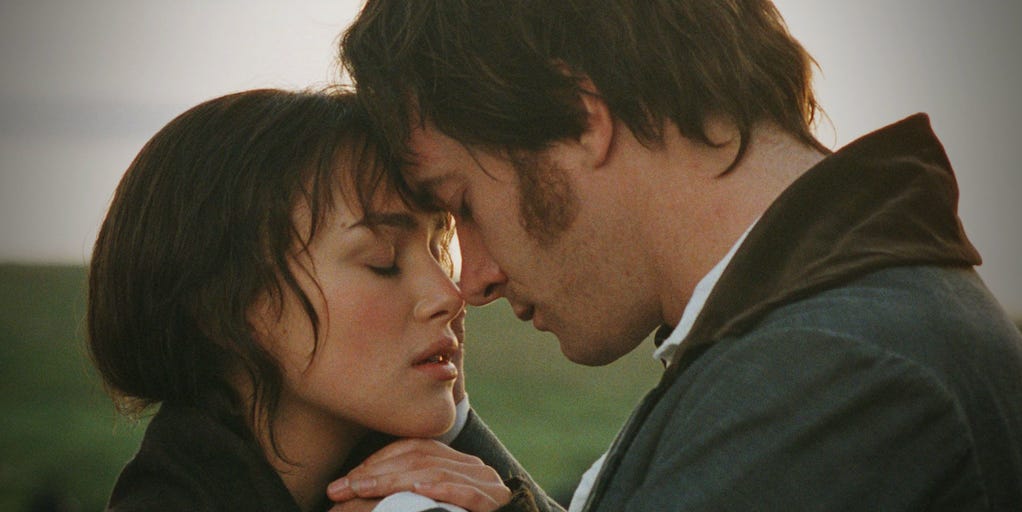
In the end, Lizzie discovers Wickham’s lies, forgives Darcy, and accepts his second proposal. It is a triumph by Lizzie of sense—being prepared to change her mind as facts and circumstances change—over the pure “sensibility” of snap judgments.
Jerusalem Demsas of The Argument wrote a terrific recent essay about Austen’s true definitions of Sense and Sensibility. Her essay helped to spark mine. 2
Channeling Austen, Jerusalem writes:
“Your feelings are not always valid. They might point you the right way, and they might point you the wrong way. The only way to find out is to use your mind.”
I make snap judgments every day. I see a stranger on the street and, instinctively, I label them purely on the basis of their appearance. Or I hear one fact about someone, and it is that one fact that characterizes the whole person.
My brain is an automatic snap judgment transponder constantly receiving and sending signals on the basis of the most circumstantial of evidence. I can’t turn it off. That’s fine as long as I don’t act on the signals. And a vote without context is a very weak signal.
Political leaders are of course a different story. About their characters and courses of conduct, we usually have a great deal of evidence over a sufficient period of time. That being so, at any fixed point in time, we can use proper proportions of our sense and sensibility to render definitive judgments.
Here is the scene of the disastrous marriage proposal. The sense of the words and the sensibility of the body language are almost completely opposite.

You lost my attention at the mention of Robert Reich, the archetype intellectual so often described by Thomas Sowell, who will live well by spouting ideas he will never be held accountable for. Like, nationalizing Musk assets and a total government takeover of AI.
Anyone who can intertwine modern US politics with Austen gets a 💗. And not just any Austen, my favorite Austen and my favorite version of Pride and Prejudice. (I know Austen purest (s) are aghast)
Truth be told, there were 2 political parties that never actually liked each other but there was some semblance of respect in understanding that we all wanted the same thing, a better country we just had differing views on how to get there. Now make no mistake dems and repubs never got along ever. They did not socialize. They did not go get coffee. They did not party together. (Family was in DC during the Reagan years so experienced this first hand)
But it just went downhill when the uniter in chief, Mr Obama took the reigns of the democratic party with his denigration of rural America and Hillary with her "basket of deplorables." Trump may have be in his own class, but he didnt start the fight and its why so many voted for him in the first place, because they didnt like being considered human garbage because they did not buy into the culture wars of the democrats.
Now, does it have to be that way? No. But it seems it is going to be for a very long time. religion used to make people think they were better than others. Since Americans have become more irreligious they are using politics as their "religions." Its being on the right side of history and thinking of yourself as the saviors of humanity, for what its worth. People for some reason need to feel superior to others when it comes to their ideals, instead of being able to agree to disagree on basic issues.
Years ago I was discussing some of the issues of the day with a person I worked with, who was a democrat, and he said that they have to have school courses in spanish because hispanic people find it harder to learn english so they need extra help. I mentioned that if i, as a republican (i have since become an independent) said that, he would have called me a racist. He had no answer and literally just stared at me.
Honestly, I think that interchange sums up American politics and perspective.