


Many years ago, my eleven-year-old son announced he was upset because he had been born into Judaism without anyone asking either his opinion or his permission. He said he was going to opt out of Judaism when he grew up and what did I think about that!
I told him I thought the way he was scrutinizing and questioning his Jewish identity was a quintessentially Jewish thing to do.
Being Jewish is an indelible identity, not just a religion. Even those who seek to mask their Judaism or to renounce it or to avoid Jewish rituals and traditions are acting in response to their Jewish identity.
In 1940 my paternal grandfather Alfred changed his last name from Rottenberg to Roberts. In December of that same year, Alfred decided to celebrate Christmas for the benefit of his three-year-old son Billy, my father.
In the 1930s, Alfred had graduated from Harvard Law School, a place where that era’s antisemitism would have been obvious––most law firms would not hire any Jewish lawyers.
Alfred then married a Jewish heiress Betty Block whose original family name had been changed to Block from Bialoblotcky. I suspect there was pressure from Alfred’s Block in-laws to change his name and to assimilate.
Alfred’s father, my great-grandfather Samuel Rottenberg, was not happy with his son Alfred’s name change and move toward assimilation. I have three beautiful letters Samuel wrote to Alfred expressing Samuel’s displeasure. In one letter, Samuel wrote, “you have no right to deprive [Billy, my father] of his birthright.”
A Rottenberg by any other name
Shakespeare claims that a rose by any other name would smell as sweet, i.e., would still be a rose. I disagree. Names have great power. I think of Moses at the burning bush asking God for His name. God refuses and replies “I Am Who I Am.”
I think that’s the all-time greatest name-flex. Second place in the footnote.1
I wonder how different my life might have been as David Rottenberg vs. David Roberts. Rottenberg is a name that even my most dull-witted classmates could have used to tease me. But as a Rottenberg I might have felt a deeper affinity early on to my Jewish heritage because my Jewishness would have appeared more obvious, at least to myself.
Escape vs. embrace
I’ve been thinking about the Rottenberg-Roberts name change and the tension between escape and embrace of Judaism ever since I devoured Nicholas Lemann’s terrific new book Returning, which tells the two-hundred -year story of how Lemann’s Jewish American family wrestled with their Jewish identity. 2
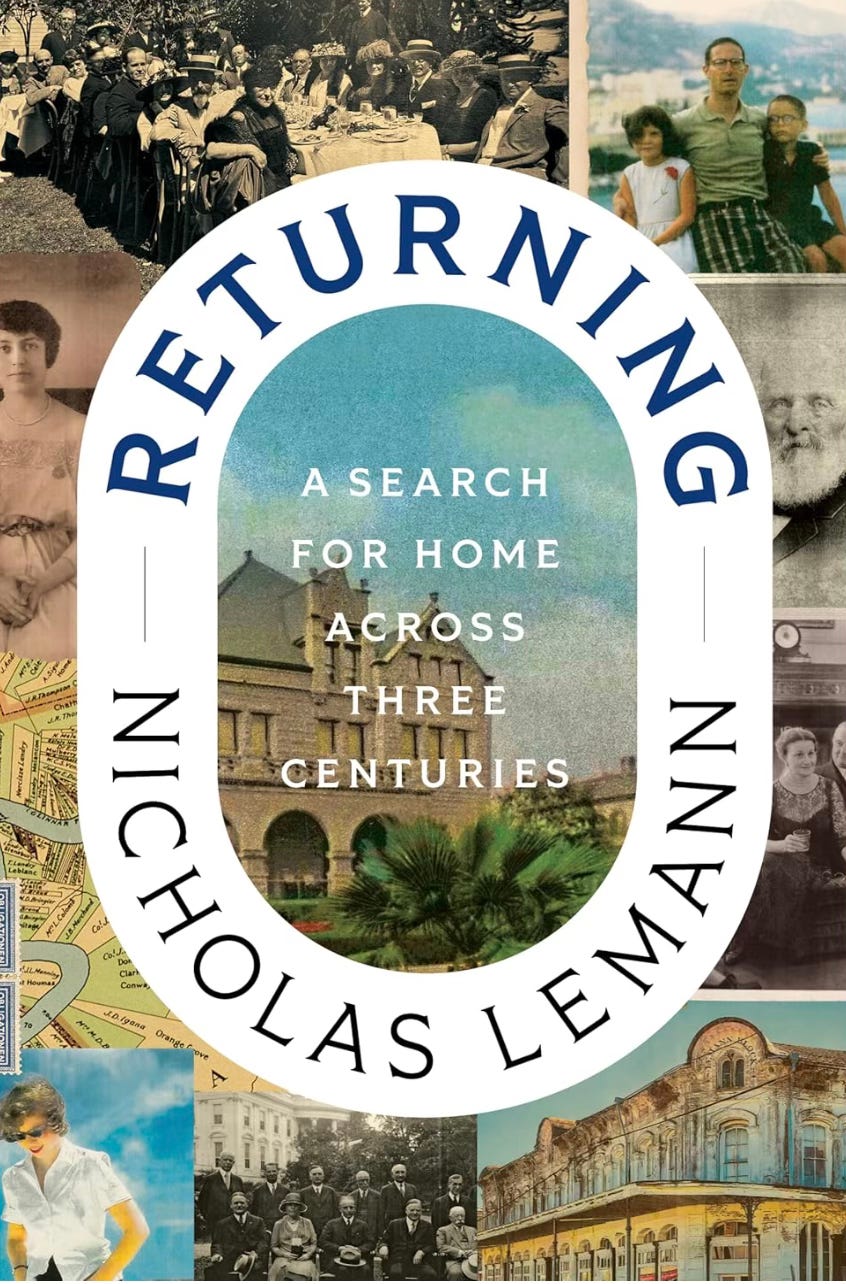
Reading Lemann’s book had a huge impact on me. It made me feel closer to my own ancestors, like Samuel Rottenberg, who had to struggle to establish themselves, something I never had to do thanks to their efforts.3
Lemann’s prosperous and accomplished family came from early German-Jewish immigrants who first settled in New Orleans around 1840. Eastern European Jews like Samuel Rottenberg came later and in far greater numbers, from the 1880s until the immigration restrictions of the 1920s.
The German Jews in America were desperate to differentiate themselves from the later Jewish arrivals who were generally poor, less healthy, less clean, and devout (clinging, perhaps) to their Jewish rituals and traditions, thus a people apart. The German Jews in America considered the mass arrival of Eastern European Jews to be a problem, a threat to how they’d be perceived.
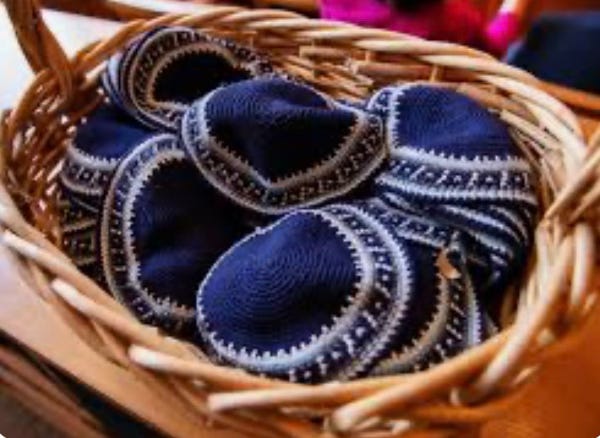
The solution for the earlier immigrants was to conform as much as possible to Christian norms. Lemann’s family, along with the rest of the tightly-knit New Orleans Jewish community, celebrated Christmas enthusiastically. Lemann recounts how at his parents’ wedding his father hid away baskets of kippot (traditional head coverings) and then did the same at Lemann’s own wedding.
Kippot were too Jewish. 4
But as Lemann writes, the distinction between the two Jewish groups, which was obvious to the more established American German Jews, was not dispositive to Christians. A Jew, no matter how cultured, how handsome or beautiful, or how rich, was still a Jew.
Lemann quotes from New Orleans novelist Walker Percey whose protagonist Binx in the novel The Moviegoer has this to say:
“Whenever I approach a Jew, the Geiger counter in my head starts rattling away like a machine gun, and as I go past with the utmost circumspection and with every sense alert––the Geiger counter subsides.”
Quintessential Immigrant
My great-grandfather Samuel Rottenberg left his family and his small town in what’s now the Czech Republic in 1888 and arrived penniless and alone in New York City at the age of sixteen.
In that time and place, helicopter parenting was not a thing!
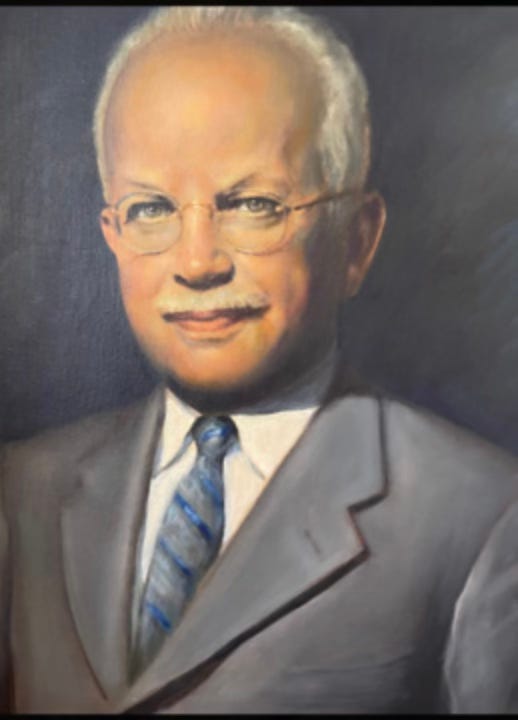
Samuel was part of the poor Eastern European wave that the German Jews looked down upon. He spent the first period of his American life as a peddler on the Lower East Side sleeping in a storeroom and earning $5 a month.
Samuel built a good life as a small business owner. He had seven children and a lifelong marriage. He became a pillar of his community, a key founder and first president of The Brooklyn Jewish Center, built in 1920 for a million dollars––really big bucks back then. It was the largest Jewish institution of its kind, combining a school, a shul, and all sorts of community activities.
As Samuel put it himself, accurately, if not modestly, “If ever some historian should write a history of the Jews in Brooklyn, I am sure my name will get some space.” It has.
Samuel’s Three Letters
Samuel wrote three letters to his son Alfred about Alfred’s name change to Roberts and his assimilation. The letters have an increasingly desperate tone. They remind me of the struggles of the father Tevye in Fiddler On The Roof as he contends with the increasingly non-traditional marriages of his three daughters. 5
In his first letter, Samuel writes that “a name to me is like a flag that a nation adopts at the beginning of its career.” And “I had hoped that my children would be proud to bear that name.”
When I first read those lines many decades ago, I felt angry at Alfred for rejecting his father’s name. I also felt shame that I was helplessly complicit in carrying on that rejection. No one had asked my permission or opinion about changing my name.
I briefly considered returning my name to Rottenberg in solidarity with Samuel (who died before I was born). But that would have been a rejection of my father’s name. And a pain in the neck. And I preferred the name Roberts to Rottenberg.
Samuel’s second letter was sent on December 20th 1940 after Samuel learned that Alfred planned to celebrate Christmas, including the traditional tree. In that letter, Samuel writes “I do not think it does us any good to ape our Christian brethren.”
Samuel understood that the Geiger counters of the Christian majority were always turned on.
Finally, the third and harshest letter comes three and a half years later in 1944. Samuel criticizes Alfred for celebrating only Christmas and excluding the Jewish holidays. Samuel has given up trying to persuade Alfred not to celebrate Christmas. Now he just wants equal time for the Jewish holidays.
Samuel blames himself for not doing a better job as Alfred’s father showing Alfred the “beauties” of the Jewish tradition. Samuel wishes that “what I am writing you today could have been written to [myself] twenty-five years ago.”
I found that especially heartbreaking. I sense in that last letter a sad and weary surrender to his son’s drifting away from tradition. All five of Alfred’s brothers eventually followed Alfred in changing their last name to Roberts. Samuel lived to witness the abandonment of the banner of his name.
He likely worried that that the final abandonment would end with complete assimilation. Conversion.
Nicholas Lemann wrote about the conversion to Christianity of the children of Moses Mendelsshon, famed father of the German Reform movement:
“The possibility of acceptance, it turns out, turned Jews into Christians far more effectively than the more brutal methods of medieval Crusades and Inquisitions did.”
Challah as dense as a brick

My parents celebrated Christmas when I was growing up. But my parents also celebrated Hannukah and I celebrated my Bar Mitzvah in a temple, all for the benefit of my mother’s father (the oilman from Tulsa) who, like Sam Rottenberg, was unabashedly Jewish.
For about a decade in the 1990s, my mother, searching for a set of guidelines to give her life greater purpose and order, became Orthodox. When she stopped her strict observances and pivoted to medical philanthropy, she retained her Jewish faith and wore a prominent Star of David until she died in 2020.
My wife and I re-entered Judaism through our three children who we sent to the Rodeph Sholom Nursery School simply because it was the one school that waitlisted our two-and-a-half-year-old daughter.
(I wrote about our zany parental behavior in my post The Manhattan Nursery School Gods, linked in the footnote below.6 )
We loved the community of the Rodeph Sholom School, part of a large Reform Congregation. We kept our three children enrolled at the school for most of their pre-high school years.
In our family home, my wife and I never had a Christmas tree. We celebrated the Jewish holidays and had Friday night dinners with our children. Every Friday, the kids brought home challah from Rodeph Sholom, crushed at the bottom of their backpacks to a brick-like consistency. The challah could have been used as a bludgeon but, still, it was delicious!
Narrow escape
We might easily have become part of the large Jewish population that is unaffiliated and Jewishly uneducated. That’s easy to do in New York, especially in the Manhattan secular private school world, and especially for someone like me who had a career in New York finance, an industry dominated by Jews.
Inside my bubble, I could have been like the fish in David Foster Wallace’s famous graduation speech This is Water. The fish can’t understand water as a separate reality from itself. Similarly, I could have been oblivious to the Jewish waters I swam in. I could have taken my Judaism for granted.
As Nicholas Lemann puts it:
“New York might be the best place to be a Jew, the most comfortable…That means being Jewish doesn’t require much of you.”
Some of that laziness is in me. I give myself good marks in my ethical and intellectual Judaism but my lackluster observance of rituals and traditions is something that troubles me.
Because without ritual, Judaism would not thrive or even survive. That’s a fact I have to face.
In the meantime, below is some comedy from Larry David about his perspective on Judaism.
Perhaps second place goes to Alec Baldwin in this snippet from Glengarry Glenn Ross.
All the quotes and examples attributed to Nicholas Lemann are from Returning.
I might not have read Returning but for my kind neighbor Nancy who stopped me one recent morning in Central Park and told me she was listening to a wonderful book she was convinced I would also love and relate to.
At our wedding in 1985, at Temple Emanu-El on Fifth Avenue, almost all rivals, including wearing kippot were absent. In the decades since, Reform synagogues like Emanu-El have returned to embracing Jewish rituals and traditions.
The first daughter ignores Yenta the matchmaker and marries the local poor Jewish tailor for love. The second daughter marries a Jew, but moves with him to Siberia, likely losing touch with her family forever. The third daughter marries a Russian, a non-Jew, which is beyond what Tevye can accept.

So very touching to read of your family’s journey from LES to 5th Ave, by way of Brooklyn. It underscores that Manhattan, small in a geographic sense, has provided unimaginable opportunity, along with hard choices, to so many. I think Samuel would be very proud of you.
Very interesting for someone like me, who has known very few Jewish people — not one until college, and then I only knew she was Jewish because of one chance comment she made. I’d never otherwise have known. Almost everything I know is from books and movies.
I did attend one Jewish service for a friend’s baby-naming ceremony. My young son whispered to me, “The books are all messed up!”