


I read an excellent expose this week in New York Magazine about the nutty world of youth travel sports and how parents of very young children are seduced into sacrificing loads of time, money, and familial life to a mostly pointless pursuit. 1
I was quick to think of these parents as numbskulls. But then I remembered my post below describing Debbie and me 35 years ago when we were subject to the whims of the Manhattan nursery school gods.
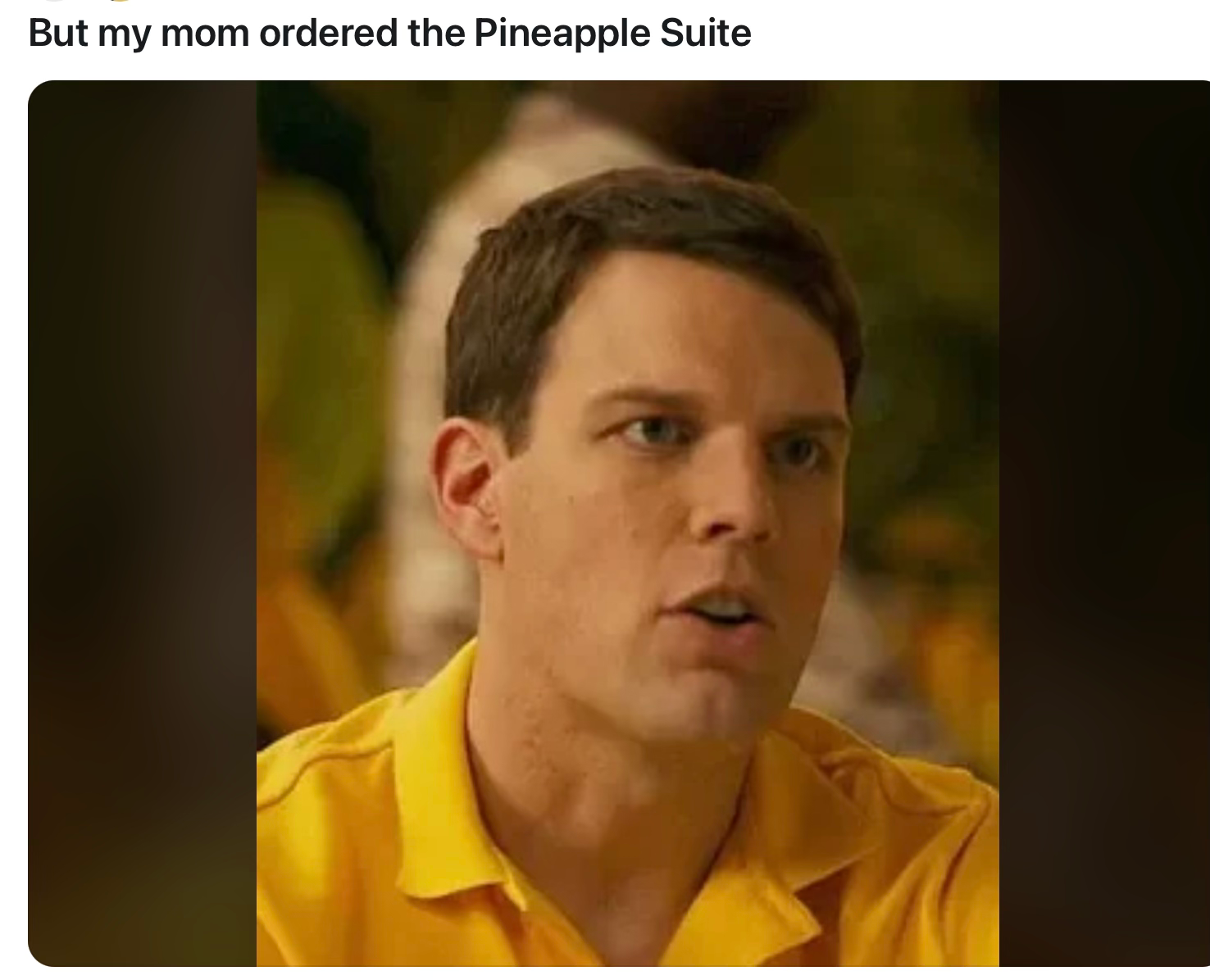
I was reminded as well of White Lotus, the Pineapple Suite, and how we can behave when we feel entitled to something that we are denied. 2
In 1989 when our daughter was not yet two years old we applied to private nursery schools. It was our daughter Lauren’s name that was on the application, but it felt like Debbie and I were the real applicants. Even though Debbie and I already knew our letters and numbers, how to tell time and, one of us, how to tie shoelaces.
Our family of three––our history, our destiny–– would be judged by the Manhattan nursery school gods. We were twenty-seven years old and we felt like a great deal was at stake.
Our options
Debbie’s family were members of Temple Emanuel. Occupying an entire block on Fifth Avenue, Emanuel was at that time, and still is, a temple of the Jewish Establishment. The vibe was highly assimilated German Jews, the early wave of Jewish immigrants dating from the earlier part of the 19th century as opposed to the Eastern European Jews like our families who came decades later.
Debbie and I were married at Emanuel in 1985. This was a time when Reform Judaism, the least traditionally demanding of the various denominations, was Jesuitical in stamping out Jewish rituals. So during our wedding, Emanuel prohibited us from reciting our vows under the traditional canopy of a chuppah or breaking a glass at the end of the ceremony. As well, no yarmulkes.
At the time, our faux-Jewish wedding ceremony didn’t bother us. So we applied to Emanuel’s nursery school and thought that because of Debbie’s family, we’d get in.
I had grown up on 73rd and Park and had attended the Madison Presbyterian Nursery School, around the corner on 73rd and Madison. Convenience in the form of proximity or otherwise ruled much of what my family did.
Debbie and I did not think of applying to Madison Presbyterian. We’re Jewish so it would have seemed odd to us. As if we were rejecting our faith.
Also, I didn’t know how careful the school was in its record-keeping.
As a teenager rummaging through my mother’s closet, I had discovered a Madison Presbyterian report card from my pre-kindergarten year in a shoebox (from Indian Walk, the politically incorrect named store where Park Avenue mothers went to buy shoes for their children.)
My nursery school report card warned my parents that four year-old David liked to put his hands around other children’s throats and delighted in laughing at classmates who couldn’t complete puzzles.
Take from that what you will. I took from it that our daughter might pay for her father’s sins. Another reason we didn’t apply.
We had a strong family connection to Park Avenue Synagogue where my parents had been married in the Appleman Chapel named for my mother’s father Nathan Appleman. We felt that a chapel named for our daughter’s great-grandfather was a strong card to play. Almost a get-in-guarantee. So we applied there.
Finally, almost as an afterthought, we applied to the Rodeph Sholom Nursery School. We remembered that the architect couple from whom we had purchased our West End Avenue apartment spoke highly of the Rodeph Sholom Nursery School where they sent their four children. They were selling because despite their design genius with built-ins everywhere, they couldn’t comfortably sustain a family of six in a 2,000 square foot apartment. They were moving back to Chicago.
We didn’t know very much about Rodeph Sholom, hadn’t really heard about it before, and considered it our “safety” school.
A shocking lack of discretion
We were accepted at Emanuel. We were accepted at Park Avenue. But we were wait-listed at Rodeph Sholom. Wait-listed!
Our worldview changed immediately.
Obviously, Rodeph Sholom was the only suitable school for us. The other two schools had shown a shocking lack of discretion in admitting us. Rodeph had higher standards. And so their standards were the ones we aspired to meet.
We played back to ourselves all our interactions during the Rodeph admissions process. One thing stood out. On a low table in the office of the admissions director, there was a wooden puzzle of four animal shapes, meant for toddlers. The kind with little knobs on the animals. I tried to fit the animals into their proper niches but struggled, then gave up. (Karma from my own nursery school days laughing at the puzzle failures of my classmates.)

Debbie was convinced that the admissions director had seen me fumble with the puzzle and had extrapolated that any child of mine would likely have inherited my spatial difficulties. According to Debbie, it was my puzzle incompetence that had led to our being waitlisted.
Shameless Effort
By then it was February of 1990. During a snowstorm (of course), Debbie, then pregnant with our son Andrew, trudged through slushy streets to deliver a long, handwritten letter I had composed pleading with Rodeph Sholom to let us in.
Did I include my family connections to Jewish philanthropy? I can’t imagine that I didn’t. In went the Appleman Chapel. In went my great-grandfather’s founding of the Brooklyn Jewish Center. Desperation can breed shameless effort. Especially at the age of 27.
The letter did the trick and Rodeph relented. Our family’s happiness and overall future were secured. All three of our children ended up attending the Rodeph Sholom Nursery School and staying for the elementary school as well. The Rodeph Sholom community has been an important part of our family’s life ever since.
White Lotus Nursery School
The idea for this essay was sparked by a“water-cooler” item below from a post on Emily Sundberg’s newsletter Feed Me of which I’m a constant reader and fan.
“If you are an aspiring screenwriter, I implore you to subscribe to Town & Country. The way they report on the .01%’s relationship with education is incredible and I need a White Lotus-type show about 4-year-olds competing to get into private school in New York City.”
I have a story for that show
I recall an admissions-related incident that isn’t completely removed from the White Lotus-Pineapple Suite brand of uber-entitlement. At the time, I was on the Board of the Riverdale Country School, a competitive school to get into.
A business acquaintance asked if I’d meet with a client of his who wanted to get his daughter into Riverdale. The connection was tenuous but I found it hard to say no. I was early in my career as a recommender.
The applying father took me to lunch at The Four Seasons Restaurant, in my memory still the restaurant that symbolizes the best of New York City. I can’t recall what we talked about other than the exceptional talents of his three- year-old daughter. I remember the father being much older than I was, probably in his late 50’s or older. His daughter had to be the product of a late or subsequent marriage.
The next day I received a package from the father at my office. He had gifted me two, over-sized, expensive Taschen art books. I was being bribed!
I didn’t know what to do with the books. I could have given them to the school but then I’d have to explain why, which would have doomed the father’s application. And returning the gift would be meeting one inappropriate act with another. So I just kept them unopened in my office.
His daughter was rejected. I was honest with Admissions that my connection with the family was a weak one. Still, they wouldn’t have held that against the application.
Soon after, I ran into the father at the entrance to a crowded charity event. He was angry with me about the rejection and asked me with a jab of his finger what kind of school could fail to see the uniquely outstanding qualities of his daughter, so obvious to everyone else he spoke to.
I mumbled something about few seats, many applicants. And disappeared into the crowd.
Meshugganah
The reality is that all parents of young children are alike. If the disappointed, art book-giving father’s behavior was over-the-top, irrational, and splenetic, who was I to cast judgment? Not me, the fumbling puzzle-man desperate to be accepted by Rodeph Sholom the one school that turned us down. Rodeph was our Pineapple Suite because it was the thing we couldn’t have.
All parents become meshugganah (Yiddish for crazy) when judgment is cast on our young children. It’s a judgment that in our human absurdity we unreasonably enlarge to a judgment of ourselves, to our past, and to our future.
Question for the comments: The private school world in pressure cooker places like NYC can seem absurd. What say you? (permission granted to cast scorn!)
The young, entitled man is on his honeymoon and is given a perfectly nice suite, but not the “Pineapple Suite,” which he believes his mother has booked for him and his new bride. He’s relentless in his pursuit of the hotel manager to right this wrong.

I sent my daughter to a preschool she loved. I don’t remember how I chose it, but fairly randomly. I was unable to swing the cost for my second child so we turned to Head Start. The program was very good. Although I’ve never been to an exclusive preschool, I cannot imagine they could have offered anything more so far as actual education and socialization skills.
Education isn’t the point of these preschools, of course! Didn’t all of us teach our children their colors, numbers, alphabet and such anyway? Didn’t we already teach them how to interact with others politely?
There is a decidedly darker purpose to exclusive schools — to preserve class structures. Even if millions of dollars had been dumped into my lap when my children were young, they still would not have been accepted into certain programs. The decision would not be made on my children’s intelligence, sweetness or personality. They’d have been denied based on my graduation from a state school, my lack of connections and my family’s total ignorance of all kinds of small tells.
It would be instructive for everyone to spend a day at a Head Start program.
Good morning David. I must take a moment to clarify your statement “all parents of young children are alike.” I would argue it’s more like “many affluent (and privileged) parents of young children are alike.” Pre-school of any type - not to mention traveling sports programs, whether for financial reasons or lack of availability, is out of reach and simply not an option for millions of young parents. That is where our focus should be in my mind. That is symbolic in my mind of how our special and beloved country is off track right now in a number of ways. We collectively need to rethink things.