


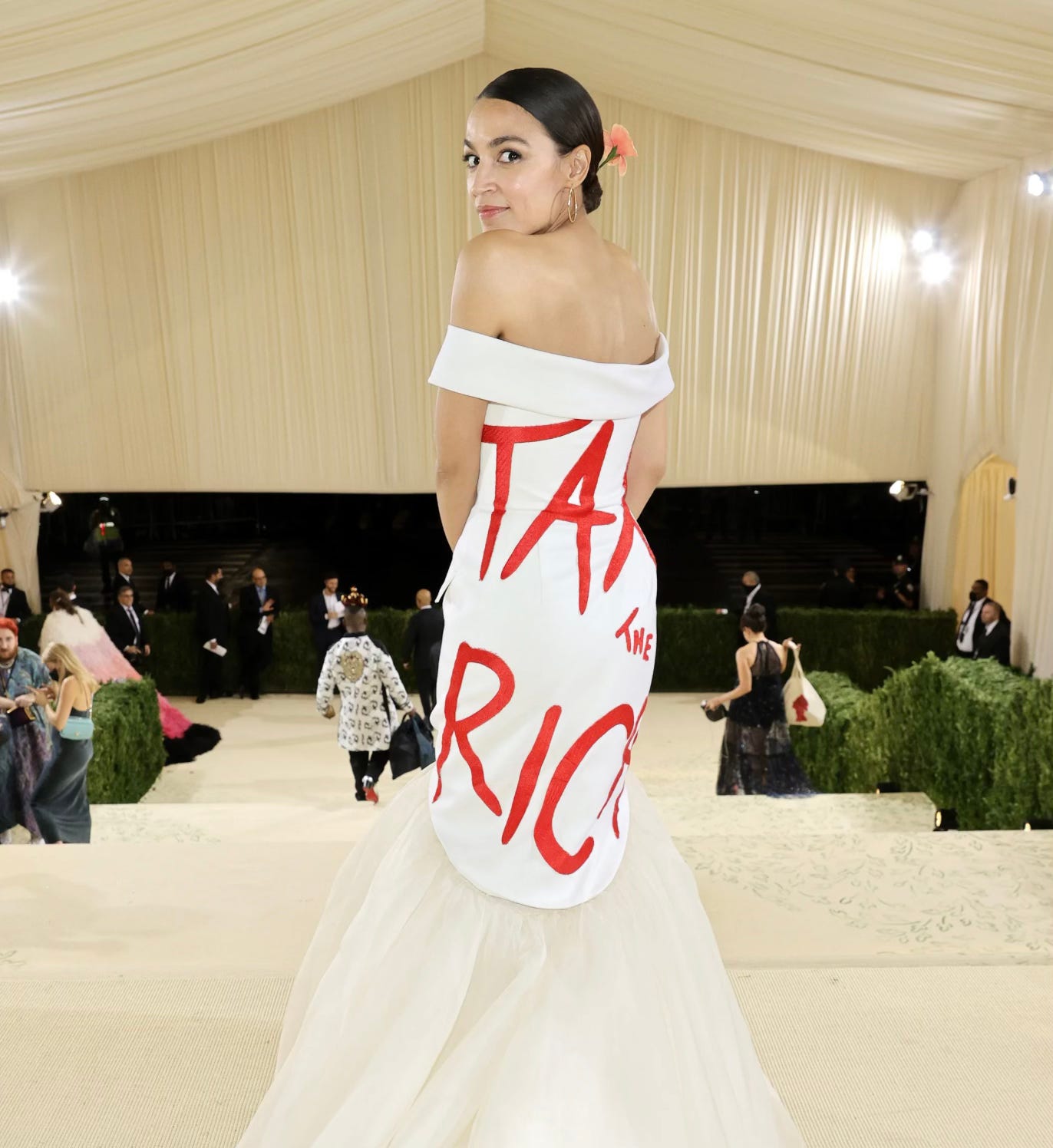
When you put taxes in your headline, you need to find a way to spice things up.
I happen to agree with the slogan snaking around the back of AOC’s dress. The rich do not pay enough in taxes, especially after the tax cuts of 2017 and 2025.
America is the wealthiest society ever to exist. We should be ashamed that we do not provide the basic needs of food and shelter and safety to the less fortunate among us.
Our tax code is at the root of that moral catastrophe.
Recently I was on a LIVE video talking about taxes with Allison Tait who writes Inheriting Inequality. Allison is a law professor specializing in estate and tax law.
Following are a few takeaways and video snippets (about two-three minutes long) from our conversation. However, you can get the gist of it from the text alone. The full conversation can be accessed via this footnote. 1
Confession of a capitalist
I’m not an exception to the general principle that no one likes to pay taxes. Or certainly not to pay more than legally owed.
And when my tax rates have been cut or when I’ve benefitted from various tax code gifts to the wealthy, I’m not at all unhappy. Even though I know that if I were the dictator of tax policy, I’d create a far different system that cut significantly against my financial self -interest.
As a prime example, current tax law says that if you sell an asset for a gain after you’ve held it for a year and a day, you’re taxed on that gain at a much lower rate than if you had held it for 364 days, the two days in this case being the difference between long term vs. short term. For the wealthy, the Federal tax rates are 23.8% for long term and 40.8% for short term.
My family has been a big beneficiary of this quirk. But it’s a quirk that I cannot justify intellectually. And eliminating that quirk would raise a significant amount of tax revenue.
Below, in a halting, hesitant, and inarticulate manner, I struggle against my self-interest, to say that, yes, capital gains should be taxed no differently than other income.
A Wealth Tax and that AOC dress
I am not a Bernie Sanders fan, except when Larry David plays him on Saturday Night Live. Bernie’s rants about billionaires and his proposals for wealth taxes on billionaires are strictly performative. AOC’s dress is more effective.
Wealth taxes are highly inefficient and do not raise much in revenue. That’s not a guess. Many European countries have tried them and soon repealed them because they were failures at raising enough new revenues to offset the costs in lost revenue and administrative headaches.
Wealth taxes have also been a boon to the accountants and lawyers who help the rich avoid taxes (legal) and evade taxes (illegal). My friend Harvey Sawikin has a great post titled Do Wealth Taxes Turn Honest Taxpayers Into Criminals?
A billionaire wealth tax is a great political soundbite. That’s it.
Below, Allison and I discuss wealth taxes.
Unsexy ways to address inequality
In contrast to wealth taxes that have little chance of raising significant revenue and may not survive legal challenges, raising the minimum wage and making it easier for private industry labor unions to organize would significantly alter the balance of power between capital and labor.
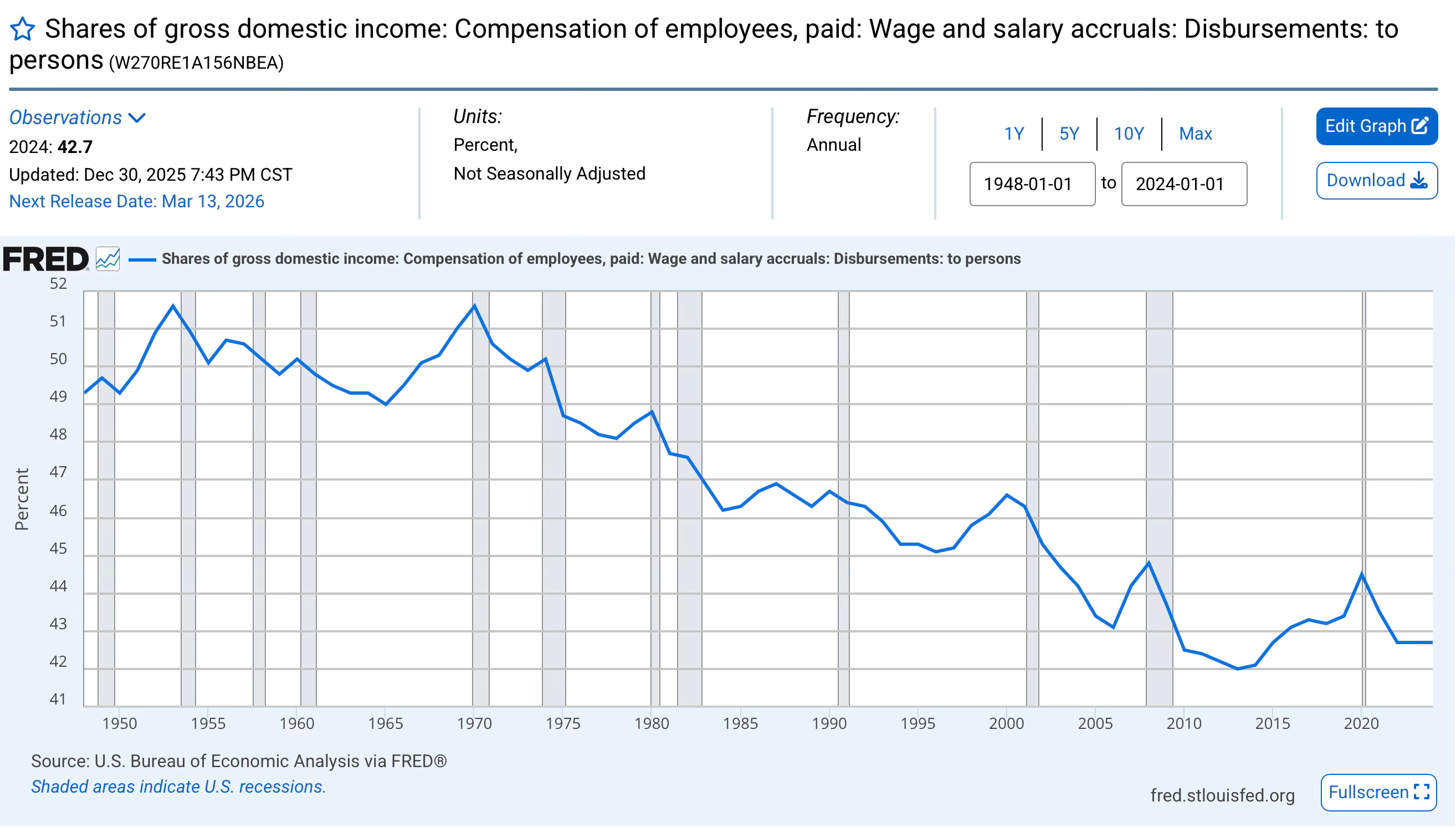
Compensation as a percentage of gross domestic income is down and while there are many reasons, those reasons include the fact that the federal minimum wage is $7.25 an hour and the private labor union participation rate has been cut in half from 1983 to today. 2
The fifty states compete for wealthy residents and businesses. Among the ways they compete are to have a low minimum wage, be unfriendly to labor unions, and of course have lower taxes. In the forefront are states like Texas and Florida and, typically, other Republican voting states who have weak state-level safety nets. 3
Here’s a chart from the Federal Reserve showing the decline in compensation as a % of gross Domestic Income.
Here’s a clip of Allison and me discussing some of the unsexy policy fixes that would not fit on AOC’s dress.
Don't tax you, don’t tax me, tax the fellow behind the tree
One of the issues with substantive tax reform is that in order to raise significant revenue, we need to increase taxes not only on billionaires but on the entire tax base of the affluent.
But as Allison and I discussed, very few people consider themselves to be truly affluent. Our natural inclination is to be envious creatures. This leads many of us to compare ourselves to those in our circles who have more. Even if we ourselves are very wealthy. 4
So raising taxes on a large swath of the affluent is a tough political challenge. And in certain rarified settings, where everyone’s a billionaire, even having five million dollars can seem worse than nothing at all as this 30 second clip from Succession sets forth.
Question for the comments: What say you about wealth taxes, other taxes, Sanders and AOC?
Full LIVE between Allison Tait and me.
Very wealthy people move to lower tax jurisdictions to save money even though a key advantage of wealth is living where you really want to live, regardless of taxes. Irrational!
I wrote a post last year about my unhinged envy at Hailey Bieber and blamed it on my jet lag and natural selection.
Hailey Bieber Made Me Feel Bad About Myself

Jet-lagged, tired, and grumpy after my flight home from Europe, I was on the WSJ website and saw a headline about a woman named Hailey Bieber making a billion dollars. I clicked her picture.
Great, informative post.
Additionally, let Allison know - I love her pizza 🍕 shirt!
We don’t have a revenue problem. We have a spending problem. Every blue state and city has high taxes and record budgets. Yet the quality of public services keeps declining. The amount of fraud and waste is staggering. Until that is fixed, raising taxes will not improve anything except making crony commissars rich.