


I had some bad news a few weeks ago. A friend close to me for a very long time died. My first reaction was to try to shelter myself from the news. To use all the good memories to protect myself.
But while the memories abide, the grief has slowly seeped in. Grief for the loss of my friend, grief for the passage of time, grief for lost opportunities to see him.
I want my HBO
When the real world seems gray, a television world provides a more effective escape for me than books do. Reading takes more effort than watching. And unlike my earlier days of reading when I assumed that every writer was an infallible genius never to be questioned, now I read with a critical eye that I cannot turn off.
These past two weeks, I’ve been watching the television show Succession for the third time and finding comfort in a fictional world that’s familiar through repetition, that’s artistically excellent, and that’s sufficiently removed from the present time in that it takes place in the 2018-2023 time period.
Young children love to watch what’s familiar to them. At age 64, so do I. Plot twists are surprises. They can startle you and make you realize that what you’re reading or watching is something outside of yourself. Newness breaks the spell.
Rolling with Kendall Roy
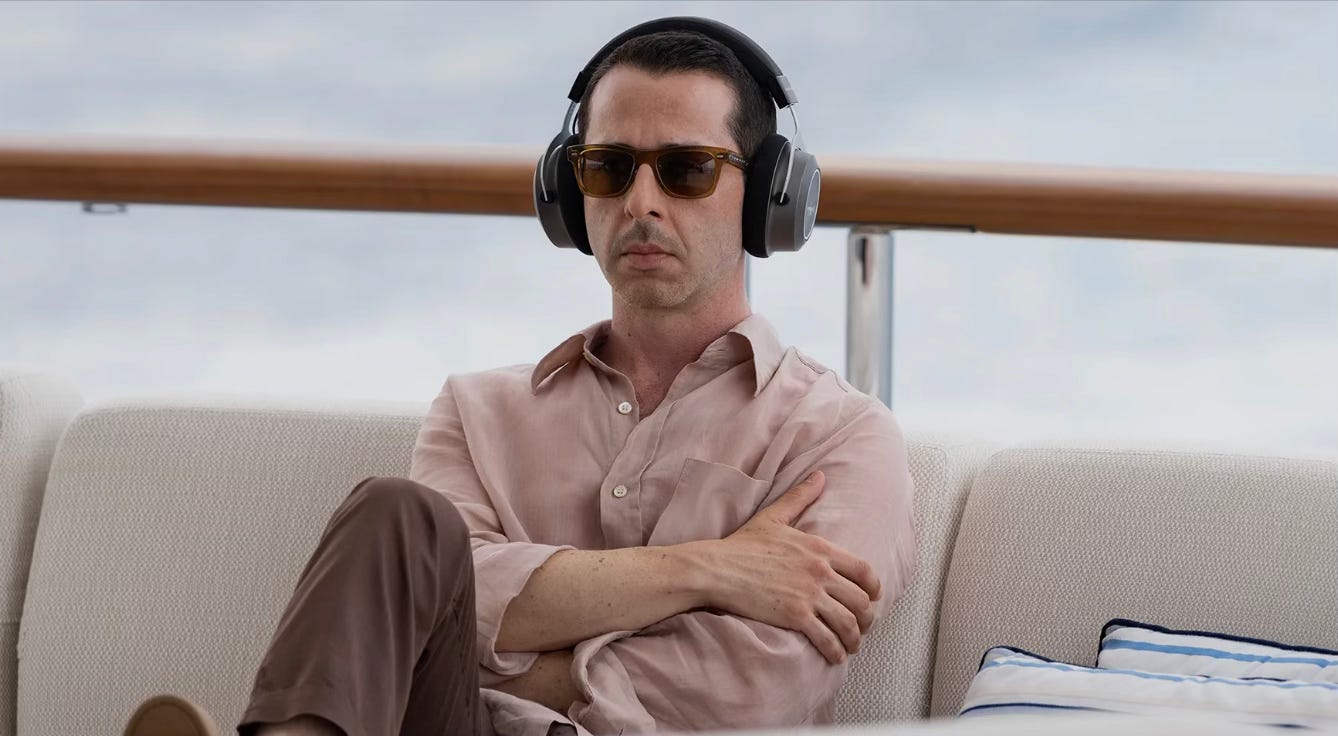
When I re-watch Succession, I’m inside the show rolling along with my favorite character, Kendall Roy, the older son, the greatest screw-up of the screwed-up adult Roy children who shamelessly compete for the favor of their father Logan, the patriarch billionaire media mogul modeled mostly after Rupert Murdoch with a hint of Joseph Kennedy.
Kendall suffers from chronic substance abuse, he’s a divorced philanderer, and he speaks with an inarticulate patter that, in its supreme awkwardness, is a triumph of writing and acting. Kendall owns the most excruciatingly awkward moments in the show, especially when he tries to be cool. It’s hard to watch him sing his obsequious rap song for his dad without feeling a dreadful yet mesmerizing sense of embarrassment. The clip of the song is at the end of this post.
To revel in the embarrassments and misfortunes of a fictional character like Kendall Roy can be a temporary balm to my sorrows. It’s schadenfreude without feeling disreputable because to feel joy at the pain of real people is an ugly feeling.
Kendall Roy, the over-the-top rich boy, is especially fit for the purpose of making me feel better about myself. I was an often awkward and cosseted rich boy too, although unlike Kendall, I grew up.
“You’re not a killer”
My childhood feeling of inadequacy connects me to Kendall Roy, who is forever failing to live up to his father Logan’s expectations. Logan is constantly diminishing Kendall, telling him he’s “not a killer,” that he isn’t tough enough, that he backs away from doing the hard thing.
Kendall wants to be like Michael Corleone, the cold-blooded killer of The Godfather. I can relate.
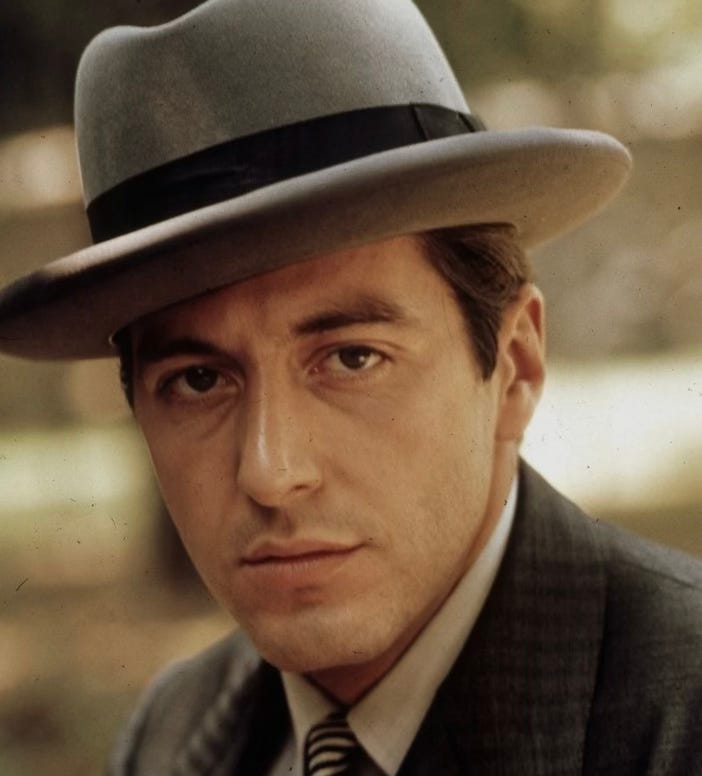
Michael Corleone is perversely aspirational for me, embodying absolute power and the willingness to kill to protect himself and his family. I’ve never been in an actual physical fight. I still regret hitting a snake with a rock in 1998, the most violent act I can recall.
Michael Corleone represents the dark side of who I can never be. If we often despise people for flaws similar to our own, perhaps we also covet traits that we lack.
I love to re-watch the Godfather but there’s no schadenfreude in it for me. Because I know now just how inept I’d be as a mafia boss.
Make-believe was my “narcotic”
I suppose the key difference in my suspension of disbelief between now and when I was younger is the nature of the fictional worlds I can lose myself in.
As a child, I used my imagination to create worlds where I could be all powerful and where I was admired and even worshipped. In those worlds I could find happiness and self-esteem, a relief from the reality of the impotent, uncool, nerdy teenager that I was.
I didn’t have many friends when I was in my early teens so I used games to assume a heroic identity. I’d play Avalon Hill war games and become the leaders of countries and supreme commanders of armies.
Or, using a nerf basketball hoop in my room, I’d become a star player of the high school team, a canny guard who could shoot well from distance and feed great passes to my imaginary friend George the tall center who could dunk.
But those were fantasies. Like Kendall, I might have imagined myself a “killer” in executing my intentions. But like Kendall, my actual execution was often more like Spaulding the hapless teenage nerd from Caddyshack, the great country club comedy.
Spaulding’s Caddyshack scenes feature his inability to hit a golf ball. That brings me back to the trauma of my 13-year-old self whiffing repeatedly on the first tee of the Hollywood Golf Club in front of everyone after I heard the caddy master tell my father, a club champion, that I was going to be a great player, just like him.
My kind father pretended it didn’t happen and whisked me down the fairway out of sight to drop a ball.
In my current incarnation and at my current age, I’ve long lost my fantastical abilities to pretend to be another person. I cannot become Kendall Roy nor do I want to.
However, I can lose myself in his gloomy aspect and in his gloomy world when I’m faced with things that bother me.
The rich boy
In his short story The Rich Boy, Fitzgerald famously writes that “the rich are different from you and me.”
A theme of my Substack is that the rich are not quite so different as most might think. We have our moods, good and bad. Wealth does not eliminate life’s inevitable sorrows.
In the same story, Fitzgerald writes that those born into wealth believe
“…deep in their hearts, that they are better than we are because we had to discover the refuges and compensations of life for ourselves.”
I disagree. The born rich are softer, more fragile, because we’ve always had our considerable refuges and compensations. We take them as a given. We’d be utterly lost without them.
In every rich boy lurks a bit of Kendall Roy. Here he is below in all his awkward glory.
Sorry to read about your friend. Life is. Sometimes it comes with two ffs. I remember the good times. It is too late to correct the bad for the dead friend.
To quote you back at yourself: ‘As a child, I used my imagination to create worlds where I could be all powerful and where I was admired and even worshipped. In those worlds I could find happiness and self-esteem, a relief from the reality of the impotent, uncool, nerdy teenager that I was.’
I wonder if our attitudes and the childhood worlds we escaped to are more a reflection of our environments than ourselves? Me. I escaped to being a London Transport bus driver, alone in my cab, waiting for passengers, trying to stay on time, all on the routes I knew well in Wembley, where I grew up in the 40s and 50s.
It remained an ambition, but you had to be 23 back then before you could drive a bus, but by then I was married, had a good job by working class standards and wanted to be a city councillor, which I became two years later. But I did have a Nottingham City Transport bus named after me in recognition of my work as a local historian and only love beats that. As always a good read, seeing life as it is as the other end of the rainbow. Regards 🐰
What stands out to me about rewatching Succession is not simply the “escape from reality,” but why the refuge is a world you have already watched three times—a world where you already know what comes next. You wrote one particularly important line: “Newness breaks the spell.”
The loss of your friend cannot be changed, and the grief has already entered. In that state, a familiar and predictable fictional world reduces new uncertainty and temporarily reduces the imbalance that reality continues to produce. Rewatching, then, is not merely entertainment, nor merely escape. It becomes an action: when reality itself cannot be changed, life changes the environment in which attention is placed, allowing the current state to move back toward stability.
This is the process described by the Life Operating Mechanism: a state emerges, the system loses stability, action occurs, and stability is restored.