

My taxes should go up but not because wealth is immoral and not because most wealthy people are greedy grifters. I want taxes to go up because when I take a hard look at the deficits and debt of our federal government, I see great peril.
A disaster such as a debt and interest rate spiral would hurt everyone, including my family and me. I’m motivated for taxes to rise by self-interest, but long-term self-interest, which is in line with the self-interest of the country.
Governments generally have two favored ways of dealing with unmanageable debt. Default or inflation. Let’s assume the United States will never default. Instead, we would inflate the debt away.
We know that inflation harms the middle class, the working class, and the working poor far more than it harms the affluent and the wealthy. The less privileged classes have far greater financial precarity and spend a far greater share of their income, often more than 100%, on basic items like food, shelter, medical expenses, child care, gas, and utilities.
So, for any leader serious about inequality, addressing the debt risk is an imperative.
Our “Locust Years”
The deficit and the associated record high national debt (as a % of GDP which is the right way to measure it) is a problem few want to face or discuss because the solutions are hard. Tax increases are unpopular both with politicians and voters.
This is the fault of both political parties. Neither has spent political capital to inform the country of the danger.
Winston Churchill memorably called the 1930s failure of Britain to re-arm and confront Germany the “Locust Years.” We are likely living through another such period with regard to our country’s finances. If we have another significant crisis, or even an ordinary recession, we are not prepared to handle it.
We need more revenue soon and that additional revenue can only come from the wealthy.
The gist
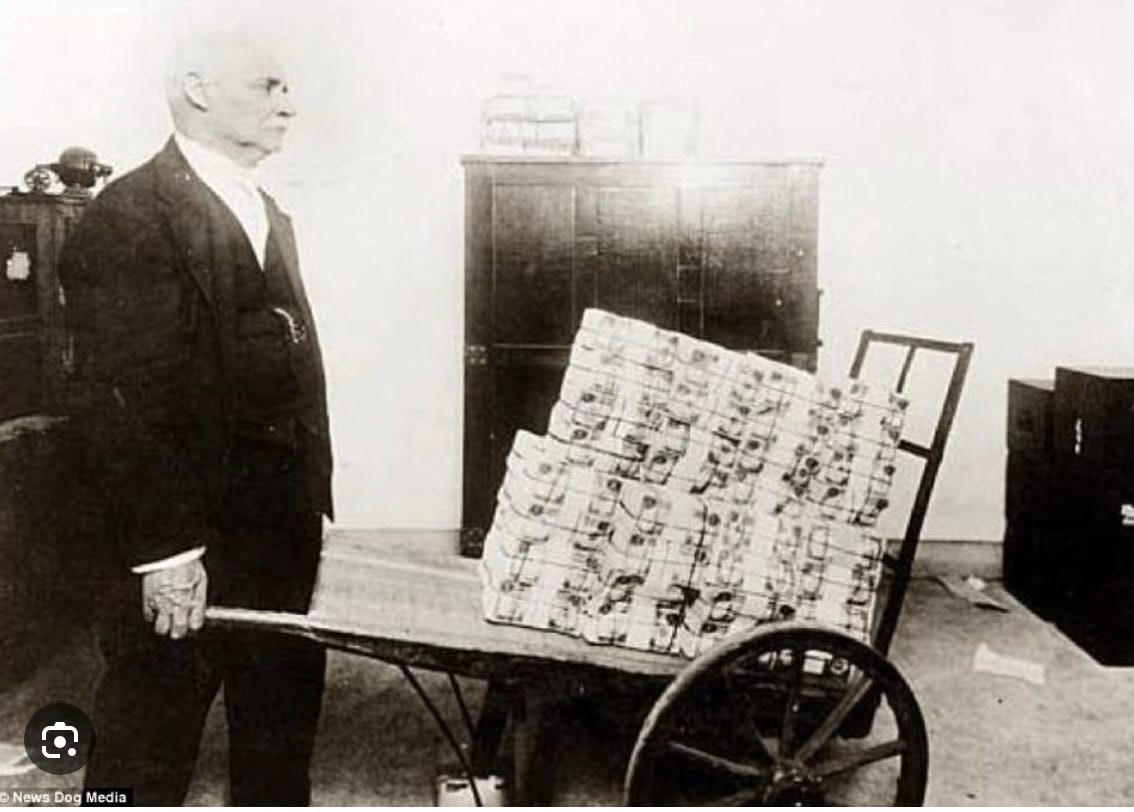
I make my case with charts and commentary—”my receipts”—in a long footnote (that I worked hard on). Check it out! Or at least scroll down to the picture of the sad fellow pushing a wheelbarrow of worthless cash. 1
Here’s the gist:
Our national debt is now 100% of GDP, as high as it was during WW2, and is projected to be 175% in thirty years.
The debt is projected to continue rising because even during this strong (aggregate) economic period, we are spending about $2 trillion dollars more in outlays than revenues, a deficit of about 6% of GDP.
The debt burden—the interest rate paid by the government times the debt—is at an all time high as interest rates have risen from historic lows.
A debt spiral happens when investors in government bonds see greater risk and thus demand higher interest rates causing the deficit to widen further.
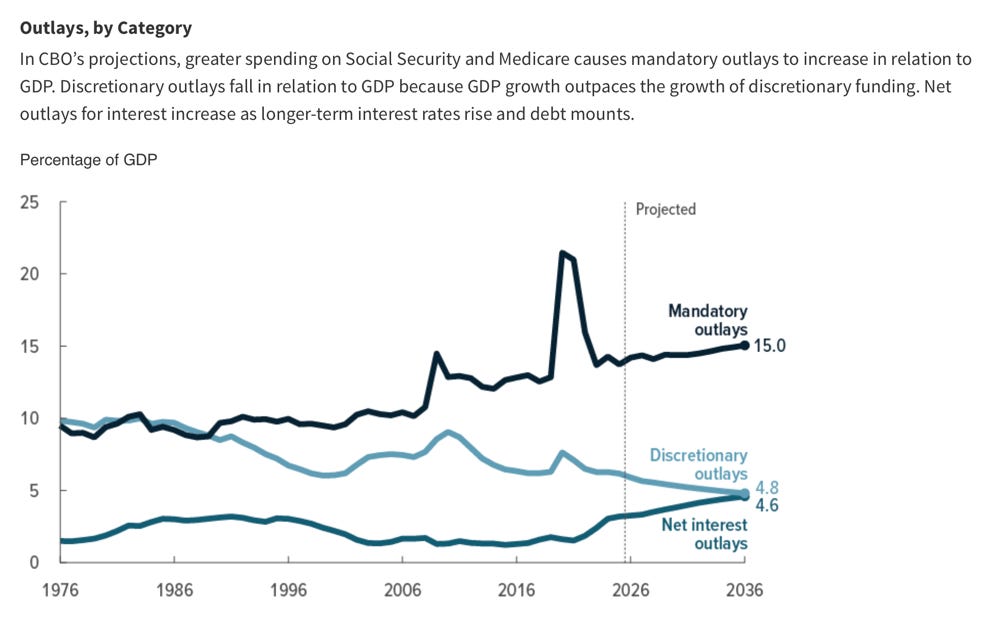
The overwhelming majority (75%) of our outlays are mandatory—Social Security, Medicare and Medicaid, pension payments to veterans, interest expense on our debt—so don’t believe the sad, old lies that we can solve our fiscal problems by “cutting waste” or by “not sending our money overseas.”
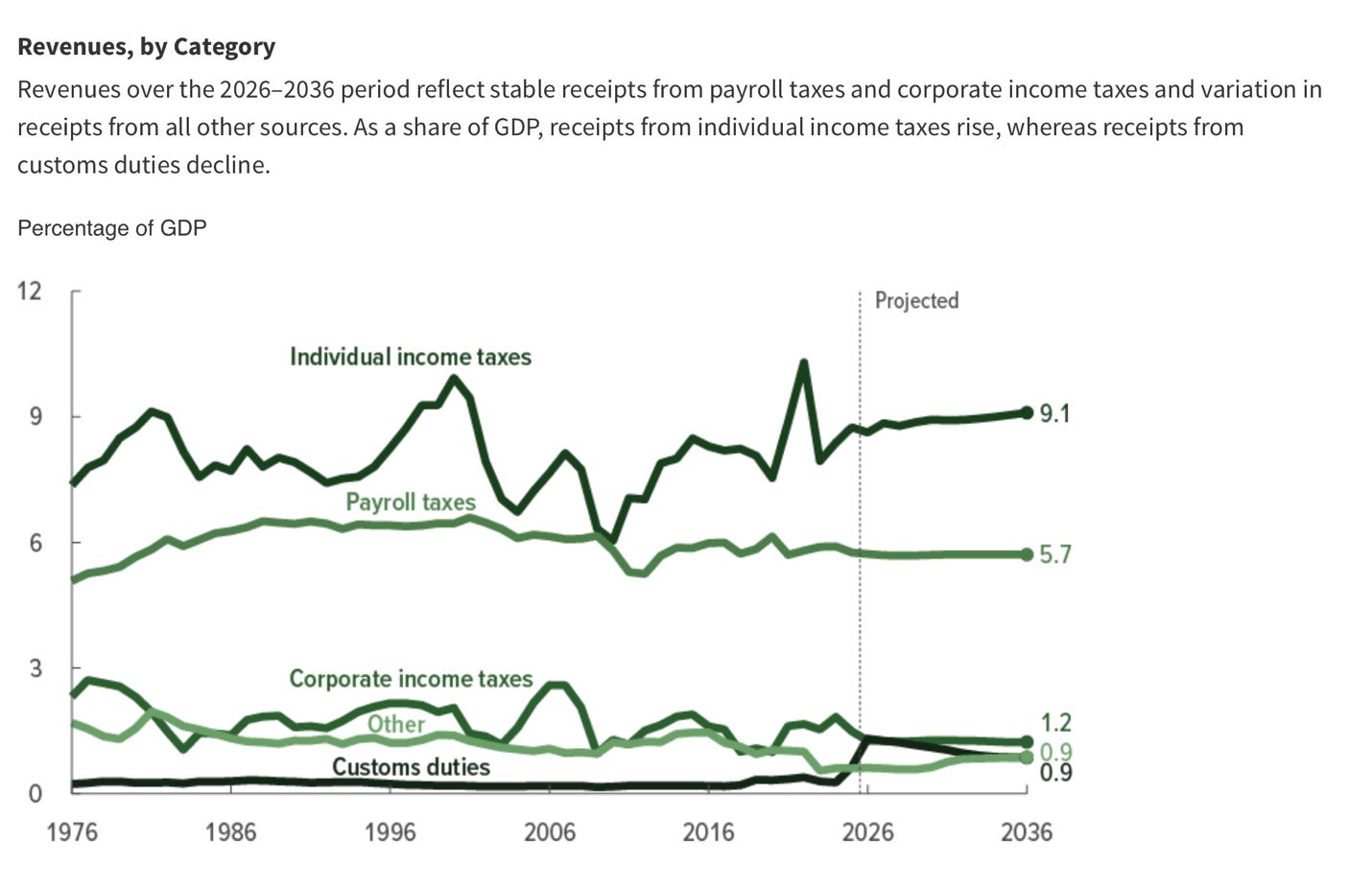
The overwhelming majority of our revenues (75%) comes from individual income taxes and social security taxes.
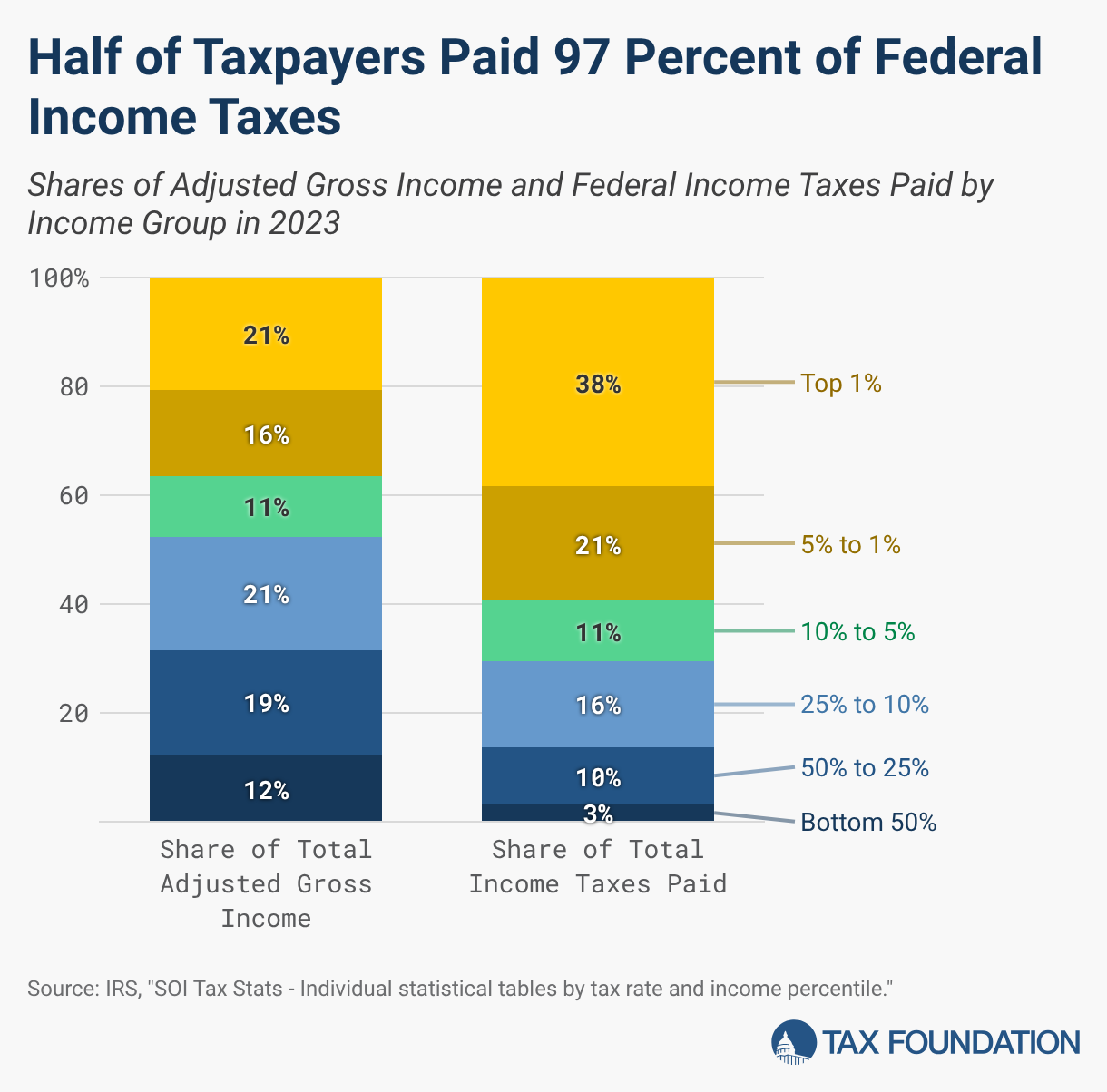
The wealthy and affluent account for most of our revenues; the top 25% in income pay 87% of income tax. That’s where the money is for more revenue.
The wealthy will not welcome an increase in their taxes
The question is not whether the wealthy as a class will oppose any increase in their taxes. Of course they will. To paraphrase James Madison, taxes are necessary because people are not angels.
The question is what approach is best suited to take the edge off of that opposition and convince some portion of the wealthy that reducing the risk of a fiscal disaster is in their long-term best interests.
This question is especially important in light of the Supreme Court ruling on Citizens United and subsequent related cases, which vitiated campaign contribution rules for corporate entities, including PACs. The effect has been to magnify the power of the wealthy to influence elections. 2
Clinton got the message right
Bill Clinton was the last president to make our fiscal health a national priority. He presented his plan in the language of shared sacrifice. He avoided demagoguery against the rich. We can learn a great deal from his success.
In 1993, newly elected President Clinton made raising taxes his top priority. He noted that from 1980 to 1992, during twelve years of Republican “trickle-down economics,” the national debt as a % of GDP doubled from 30% in 1980 to 60% in 1992 (compared to 100% today).
And in 1993, although the ten-year treasury interest rate had declined from the 15%+ heights of the early 1980s, it was still stuck at around 7%. Clinton viewed this combination of rising debt and stubbornly high interest rates as a threat to American prosperity.
The centerpiece of Clinton’s plan was to raise taxes on the top 2% of earners from 31% to 36%. Clinton sold his plan as a reversal of the Reagan policy of trickle-down economics.
“…by asking the most of those who benefited the most in the past, and by asking more Americans to contribute today so that all of us can prosper tomorrow.” 3
Absent from his “pitch” were any harsh words for the wealthy. There were no accusations of greed, no singling out of any individuals or any groups of individuals. No blame and no shame. No morality tale.
Clinton was realistic that there would be opposition. But he asked the country to face the plain facts.
“And nobody likes the tax increases, but let’s just face facts. For 20 years, through administrations of both parties, incomes have stalled and debt has exploded and productivity has not grown as it should. We cannot deny the reality of our condition. We have got to play the hand we were dealt and play it as best we can.” 4
In the end, Clinton got most of what he asked for. Crucial to passage was the support of conservative Democrats in Congress. It’s well documented that Clinton was able to convince a significant number of prominent CEOs to lobby their Democratic representatives to support the bill. 5
In a radio address just prior to the final vote, Clinton said:
“On Wednesday, I met with more than 60 corporate executives who support my economic growth plan. Many of them are Republicans who will have to pay higher taxes under the plan. But they made the hard-headed economic decision that their companies, their shareholders and their country will be better off with this economic plan because it means lower deficits, lower interest rates, and a more stable environment to grow.” 6
Bernie Sanders
Currently, Sanders is the most high-profile national leader of the left wing of the Democratic party. He is focused above all on attacking and taxing billionaires who he blames for all the country’s problems. In the past, his attacks were against “millionaires and billionaires” until it was pointed out that Bernie was himself a millionaire.
Sanders’ new favorite attack word is “oligarch.” Here’s what Sanders said from the Senate floor last year.
“And it is not just power that [the oligarchs] want. Despite the incredible wealth they have they want more, and more and more. Their greed has no end…Bottom line: The oligarchs, with their enormous resources, are waging a war on the working class of this country, and it is a war they are intent on winning.” 7
In his speech, Sanders rails against the rising wealth of Musk, Bezos, and Zuckerberg. He doesn’t mention that the increases in their wealth came from rising stock prices of their companies.
Instead, Sanders implicitly blames the increase in their wealth for the struggles of less wealthy Americans.
“Meanwhile, while the very rich become much richer, 60% of Americans live paycheck to paycheck, 85 million are uninsured or under-insured, 25% of seniors are trying to survive on $15,000 or less, 800,000 are homeless and we have the highest rate of childhood poverty of almost any major country on earth. Do you think the oligarchs give a damn about these people?” 8
Sanders believes that rich people cause poverty. He never says how. For good reason, because that cause and effect does not exist in the real world.
Below, fictional Senator Eavis from TV show Succession, next to his inspiration, real Senator Bernie Sanders. In the show, Senator Eavis has a lot in common with Bernie Sanders, including his monomaniacal and ill-tempered pursuit of Logan Roy, the Rupert Murdoch-inspired billionaire character. In the end, the hapless Eavis fails to lay a glove on Logan Roy.


We need a truth teller
It’s a matter of vital concern that our debt and deficit be addressed. It would be unrealistic to expect the Republican Party to propose a tax increase. George H.W. Bush (“read my lips, no new taxes”) was excoriated in 1990 for raising taxes by a little bit and then lost the 1992 election to Clinton.
As for the Democrats, I have heard no nationally prominent politician make addressing the deficit and the debt a priority. The truth is grim and it is the rare politician who is willing to tell the grim truth.
The truth teller we need must call for a shared sacrifice rather than engaging in performative rage politics. Because begrudging the wealthy their wealth is class war, is resented, and will lead to far fiercer opposition from the wealthy of both political parties.
That opposition would include me. I would oppose a Democratic candidate who took the Sanders/DSA approach to taxes and the wealthy. To paraphrase James Madison again, that is a cure that is worse than the disease. Attacking billionaires with wealth taxes because you think they’re greedy is not a serious approach. (NB: I am far, far, far away from being a billionaire).9
I’ll give Logan Roy of Succession the last word.
“My receipts”
The charts below from the Congressional Budget Office and The Federal Reserve tell the tale of my concern.
First, the history and projection of national debt as a % of GDP if we keep on our current course.
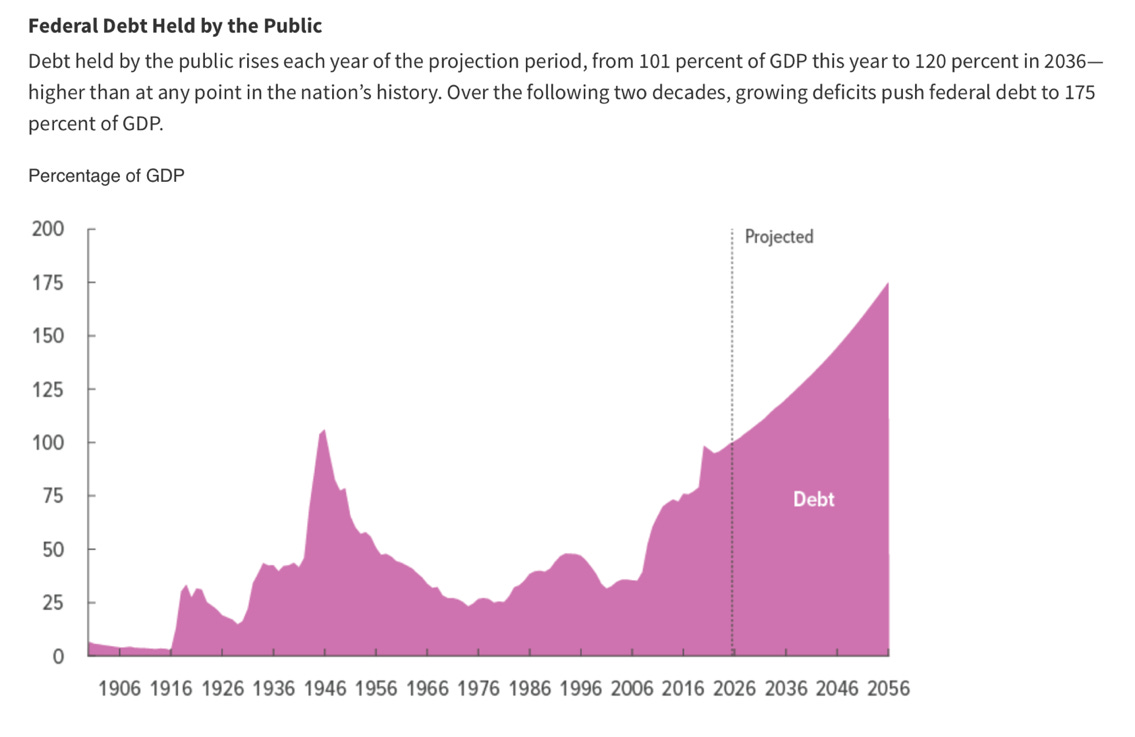
The sharp peaks in the 1940s and early 1950s were caused by expenditures for World War Two and the Korean War. The debt then went down in part due to GDP growth but in part due to a series of very significant tax increases that had bipartisan support (1942, 1943, 1950, and 1951). U.S. Treasury Analysis
The increase in debt in the 1980s was reversed by economic growth and Bill Clinton’s budget bill that included both spending cuts and tax increases on the wealthy.
Now, in 2026, we have climbed to a precipitous peak of debt, not because of an existential crisis like a World War, hot or cold, but because of fiscal carelessness during generally good times for the aggregate economy.
The chart below shows why our national debt keeps growing. We’re not collecting nearly enough money to match our expenditures.
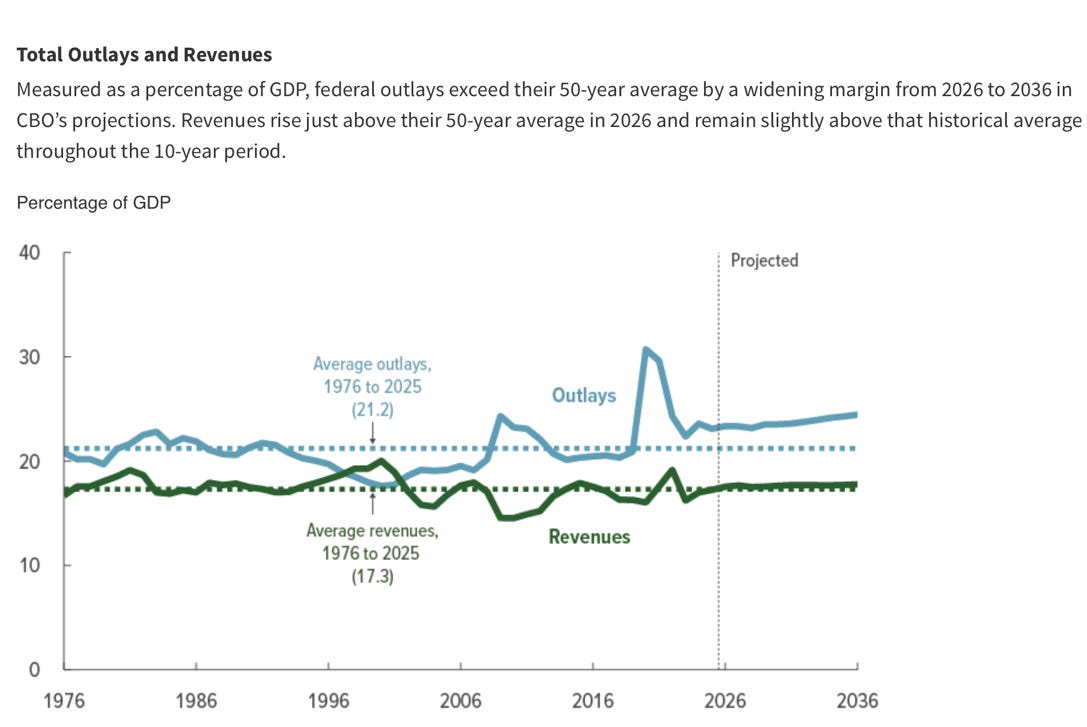
The sad old lies that if we could “just cut waste” or “send less money overseas,” we could solve our deficit will always be sad old lies no matter how many times politicians repeat it. That’s because 75% of our expenditures are composed of mandatory outlays such as Social Security, Medicare, and Medicaid and interest expense on the debt. The remaining “discretionary outlays” are roughly half defense, half for everything else that the federal government does.
If we want to make a dent in the outlays, we would have to reform entitlements, perhaps even more of a political “third rail” than raising taxes.
About 85% of the revenues to pay for our government comes from individual income taxes and social security taxes. So, if we’re going to increase taxes, that’s where the money is.
Note: the problem with increasing corporate taxes is that it is relatively far easier for corporations to relocate to more favorable tax regimes than it is for American citizens to give up their American citizenship. Also, there are countries like Malta that give corporations opportunities to profit-shift. See this NYT article from 8/5.
The people who pay most of the taxes are the wealthy and affluent, so that’s where additional revenues need to come from. The top 5% of income earners pay almost 60% of federal income taxes, the top 25% pay 87%.
Note: the chart below is based on federal income taxes, not social security or local taxes which are far less progressive.
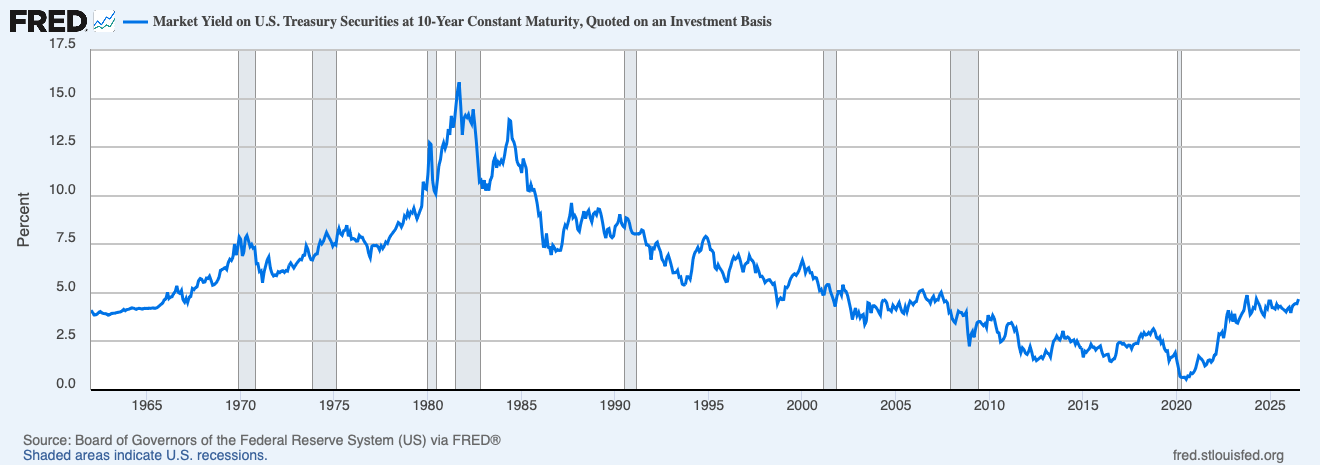
To put the national debt in context, we need to recognize that there are two components of interest expense, the amount of debt and the interest rate paid. Debt can be very high but if interest rates stay low, it can seem like the debt is not a problem. And ever since the 2008 great financial crisis, we’ve had generally low interest rates.
The ten year treasury rate is a good proxy for the expected cost of government borrowing over the near term future. Note that the interest rate on the ten year Treasury was in the teens in the 1980s and fluctuated between 5% and 7.5% for most of the 1990s.
Now the ten year treasury is at 4.65%. It’s true that expectations of inflation are often the chief driver of interest rates. However, all other things being equal, the higher the national debt, the greater the risk perceived by investors, and hence the higher the interest rate demanded.
The next chart takes the amount of debt and multiplies it by the ten-year treasury rate to arrive at an interest burden. It then calculates the interest burden as a % of GDP.
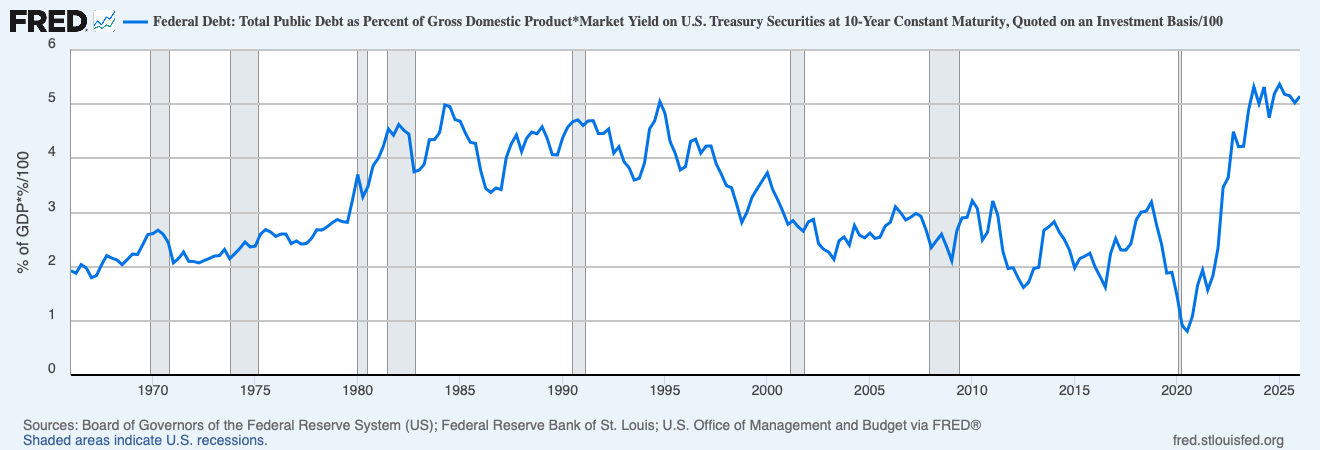
Sounds complicated but the bottom line is that as a country we are currently set to use about 5% of our total output to service our debt. That’s an all-time post-war high, matched only during periods when the interest rate was significantly higher.
So, if buyers of treasuries demand higher rates because they see the Federal Government not doing anything about deficits, we will have to devote more money to interest expense and the deficit will widen and we will have more national debt and interest rates will rise further making deficits worse, and the awful spiral that has been the ruin of many a nation will take its deadly course.
Ibid.
Ibid.
I do not propose specific tax policies in this essay, although I have some general ideas of what seems workable and what does not.
What I think works–––keep it simple and use the taxes we already have
1) Increase the rates of income tax for higher earners. Perhaps on the top 5% or 10% of earners. Income taxes is an obvious source since this is how the govt. collects half its taxes.
2) Social security taxes are now levied only on incomes up to about $180,000 and are not assessed on benefits employees receive. Eliminating the cap and making benefits subject to the social security tax seems fair to me.
3) Subject investment income to the same tax rates as wage income.
What I think does not work
1) Wealth taxes: Many European countries imposed and then abandoned them because they failed. A wealth tax will be a boon to lawyers and accountants who will devise all sorts of clever strategies to avoid it. There is a good argument that wealth taxes are unconstitutional; our ideologically conservative Supreme Court would decide. Finally, if it’s the Sanders plan to tax half the wealth of the thousand American billionaires, those are the thousand people most able to switch tax jurisdictions.
2) Increase state taxes and spending to relieve the federal government of expenditures: the problem is that the fifty states compete with one another for businesses and residents. States that have unique characteristics––there’s only one NYC––can get away with higher tax regimes but there’s a limit. Moving from NYC to Miami or from LA to Austin to avoid state income taxes is many degrees easier than giving up American citizenship to avoid American taxes. At current tax rates, there’s already been some shift from high local tax regimes to low local tax regimes.
Also, unlike the federal government, states and cities need to balance their budgets.
3) A national sales tax, i.e., a VAT like most European countries have. Hard to avoid making a national sales tax regressive. And it introduces more complexity to an already extremely complex tax system.
I agree with the sentiment, but taxation is inherently coercive.
Coercion always ends up a tool of the resentful, it's just in the nature of envy.
Good analysis, but it misses one essential ingredient: spending. Specifically, government spending. Faced with increased income, our Congress could find programs to spend it on, likely totaling more than what is realized by the increased taxes. I'll agree to increased taxes if you'll agree to frozen government spending. Otherwise, it's like a dog chasing its tail. As for a national sales tax, it is regressive.