


When reading a novel that grips me deeply and refuses to let me go until the last page, I latch on to the main character and adopt their point of view. Especially if the main character is a man who’s within spitting distance of my age of 64.
I live with that character for a day or two and end up knowing more about him than I do about almost anyone else in my life. I fall under a spell, and this character becomes real to me. My instinct is to like him. And I want him to like me back just as much.
If he has a dark point of view, he darkens my mind. If he becomes despondent, I become despondent. My negative thoughts can leave the novel and spiral.
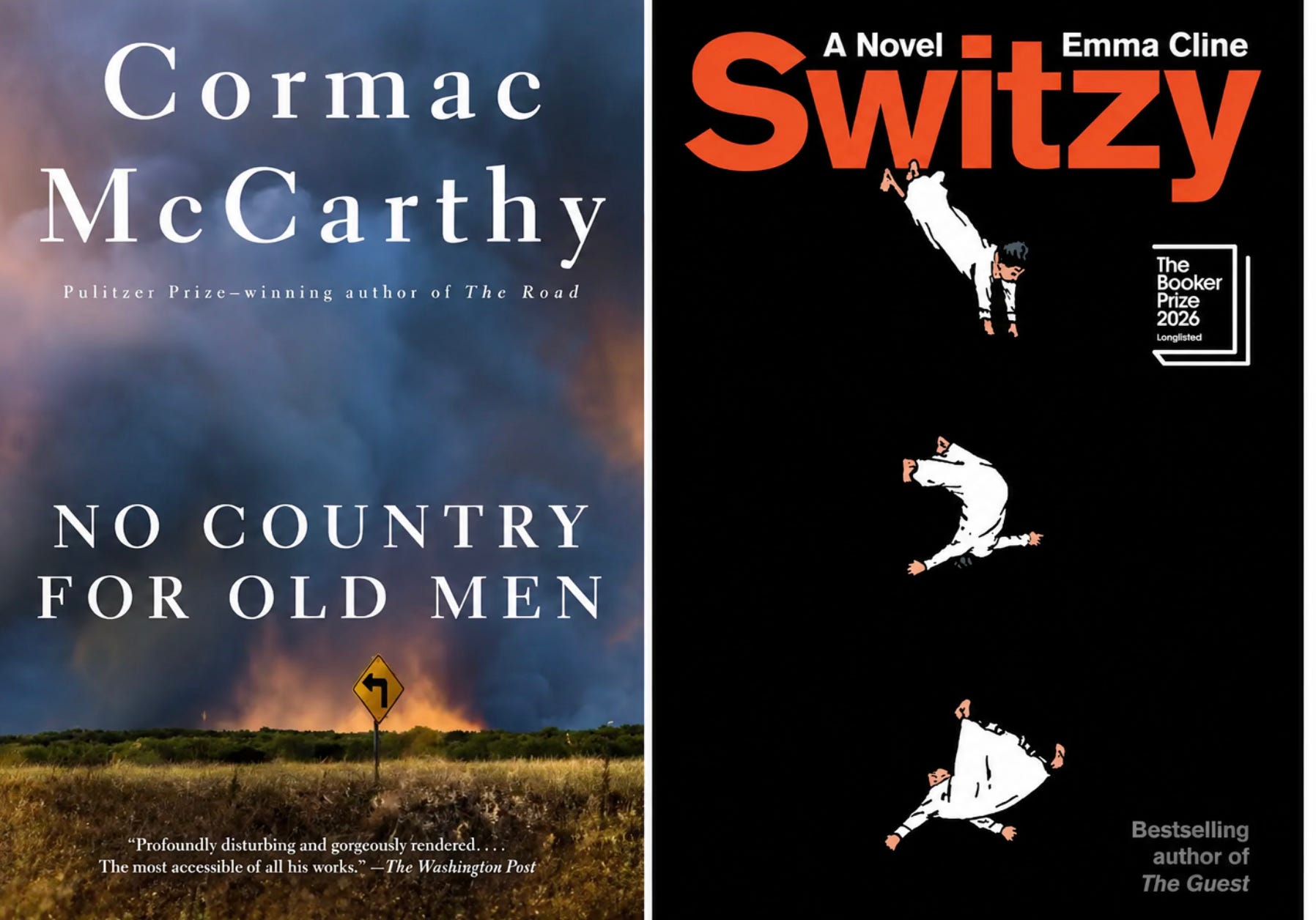
This week I was affected in this way by reading two very different books with two very different main characters, one of whom is named David.
A sea change
In Emma Cline’s new novel Switzy, seventy-year-old finance guy David has Alzheimer’s. He’s in a perverse “sweet spot” of the disease. It’s advanced far enough to make him fully aware of its awful and inevitable end state, but not far enough to prevent him from making an informed choice to request an assisted suicide in Switzerland. Hence the title of the book.
Until it was cut short by his disease, David had a lucrative career serving the financial needs of wealthy people. He’s gotten used to material comforts like luxury hotels and frictionless travel in private planes and private car services. His life is familiar to me.
The David we meet in the novel will cease to exist, whether by suicide or by the disease. He will suffer a sea change, a Shakespearean phrase meaning a body lying long drowned in the sea, “five fathoms deep.”
David seeks a silver lining
David tells himself his fate is for the best because modern life has passed him by. He no longer understands it or likes it or fits in. In a phrase used often in Switzy, “it’s time to leave the party.”
David thinks his disease was not spotted sooner because in today’s digital/AI world, everyone’s brain is addled by information overload. The world has become disenchanted of all its beautiful mystery—“this relentless march of knowledge, this breaking down of the world.”
In London before he gets to Switzerland, David visits the Wallace Collection and sees a beautiful wooden herringbone floor as a rare vestige of a time when “human ingenuity…match[ed] human need.”

As well, the comfort of shared experience, the very meaning of a day and a night, has been shattered into “a million mental jaunts available to you in every moment, consciousness in a constant state of fracture.”
The culture David once knew has been degraded. On his way to Switzerland, David checks into a posh London hotel (the Berkely?). In the stately lobby, tourists wearing athletic wear wheel the “clanking donkeys of their suitcases” over the marble floor, marring David’s memory of the once-glamorous setting.
In the hotel bar, David thinks about how people are avoiding alcohol and instead of the communal grace of drinking together, the modern narcotic of choice is to name and pathologize “every granular tick of emotion and vice.”
David concludes that he’s an unwelcome dinosaur in this world, an unwelcome reminder of how things used to be. The world will be better off without people like him. “He’s not sorry to be leaving.”
And in a tacit reference to AI, David decides that the disease taking away his facility with numbers and finance is not really a loss because his skills have already been usurped by computers.
When the world seems out of joint
I found myself susceptible to David’s point of view. There is so much about the world I find alien and incomprehensible. Our raging politics on all sides, our berserk financial markets, artificial intelligence, the monstrous amount of information and choices. Plus, everyone is so young!
Like David, I’m retired although by choice not necessity. As David says about retirement, “it was its own job.” In retirement you lose the convenient ease of the daily grind and it’s up to you to “keep the brain and body stimulated.” It’s “extra work” to curate every day into something resembling life. Many days I feel that and wonder what it is I’m actually doing.
As I was communing with David, my mind started wandering off in a dangerous direction. I wondered whether I’d already entered a period of senescent decline, bewildered by so many things I can’t understand. Was my usefulness, my relevance, reaching its end state.
As well, I recently lost a close friend who was 71, a stark reminder of mortality and inevitable loss.
“One of the things you realize about getting older is that not everybody is goin to get older with you.”
So says Sheriff Ed Tom Bell from No Country For Old Men, the other character from the other book that affected me when I read it last week.
A hard man hard on himself
Small town, West Texas Sheriff Ed Tom Bell, war veteran and tough as nails, couldn’t be more different from me. I’m the ultimate city slicker.
Yet like David in Switzy, Sheriff Bell shadowed my mood as he spoke to me in an elegiac tone of things lost and never to be recovered, of being overwhelmed by change.
When Bell started out in the late 1940s, some Sheriffs were so respected and so successful in protecting the people in their county, they didn’t need to carry a gun. Now in 1980, drugs, cartels, military-grade weapons, and vast sums of illegal money have come to the county near the Mexican border that Bell has sworn to protect.
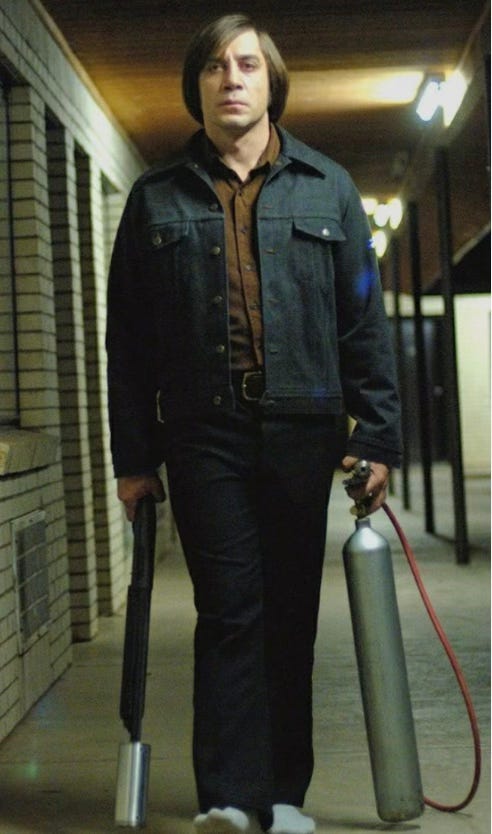
Evil has come as well, personified by the sociopathic killer Anton Chigurth, a “true and living prophet of destruction.” He’s real but inhuman and indestructible. He can’t be deterred from following his code of killing. Chigurh is our worst fears of AI come to life.
Sheriff Bell counts himself as a failure because he cannot protect the people in his county from Chigurh and the violence of the drug dealers. Bell accepts a bitter defeat and decides he will not confront Chigurh, even though to do so is Bell’s job.
Another retiree
Instead, Bell retires at age 57. It’s the second time he feels like he’s “stolen his own life.” Thirty-six years ago, in France during WW2, Bell’s squadron was overwhelmed by Germans. Bell put up a valiant fight and survived. But everyone else in his squad was either killed or severely wounded.
Bell had taken a “blood oath” to stay with his men, no matter what. But he runs to save himself, leaving behind what’s left of his squad. He’s carried his guilt around ever since. Now he thinks he’s committed the same sin by failing to confront Chigurh.
Bell is unremittingly hard on himself, a trait I can relate to. I could relate as well to Bell’s feeling of impotence and helplessness against forces he knows he cannot defeat.
He’s confused about his life, trying to see it clearly.
“I tried to put things in perspective but sometimes you’re just too close to it. It’s a life’s work to see yourself for what you really are, and even then you might be wrong.”
I get confused and frustrated as well trying to describe my life. My words often seem askew and insufficient. Barriers rather than breakthroughs.
Trying to snap out of it
One advantage of being older is a keener understanding of your vulnerabilities. I recall spiraling into a depressed state after seeing the last Lord of the Rings movie in 2003 when I was 41. I was triggered by Frodo’s sadness when he returns to the Shire after his heroic defeat of Sauron and realizes his dream of returning to a normal, jolly life is no longer possible.
So, I recognized the feelings sparked by these two books. I recognized the danger to my mental health.
It was simple to distinguish my life from the David of Switzy.
Switzy’s David devoted his life to his financial work, driven by a “feeling of terror” as to who or what he would be without his job. The cost of his all-in devotion to his career was losing his wife to divorce and his daughter to alienation. He has no family.
Regrets
The fictional David of Switzy is unable to sustain his silver lining rationalization that his disease isn’t such a loss—the trope of its time to leave the party. That rationalization becomes a house of cards when he realizes he’s failed at human connection.
He remembers a moment, presumably during his divorce many decades ago, when he and his ex-wife have an open house to help sell it. The realtor hires workers to wash the house’s windows to perfection, to wash them as they’ve never been washed before.
David remembers seeing their house with new and lovely clarity, but what he’s really seeing in his memory is the family life he could have had but is now lost to him, irretrievably.
“They had missed forever their chance to enjoy the real house…it could have been this way all along. But too late now. Too late!”
Sheriff Bell also has regrets over his failure to protect first his squad in 1944 and then his county residents in 1980. He feels defeated. The reader feels defeated, too. We want Bell, the good man, the protector, to triumph over evil.
But Anton Chigurh is an evil that Bell can neither understand nor prevent. And going up against Chigurh would be just a different flavor of assisted suicide than what David contemplates in Switzy.
So instead, Bell protects what he loves most, his wife and, for her sake, himself. Bell will curse himself for quitting the fight for as long as he lives. But it’s braver than offering up himself to Anton Chigurh as a sacrifice to his pride.
Doomscrolling
I don’t know if current times are truly different or worse. But I know I didn’t have these feelings of incipient doom when I was younger. I suspect these two books wouldn’t have affected me so much when I was younger.
We call it doomscrolling. We think we’re on the precipice of a financial meltdown, the other political side is crazy or evil, AI will kill us all. It’s deeply unsettling and disorienting. And some of it may even be true.
I have a large, growing tightly knit family. I have a great deal to protect and love and be grateful for.
All I can do is not lose myself obsessing and agitated over anything that takes me away from the people I love.
Question for the comments: Which fictional character has affected you the most?
David, so much of what you say resonates. However, we as humans have been at the doorstep of doom before - the Civil War, the Great Depression, the Industrial Revolution, the black plague, the rise of Third Reich, AIDs, 9/11. I could go on. Most people are good at heart and want what’s best for themselves and others. In my mind we must hold on to that faith, control what we can, and continue to demonstrate caring and kindness whenever the opportunity arises. A perfect solution, no. But I think we will collectively persevere and face these challenges together.
Stories about "Davids" are dangerous to read...and live up to...